
Free Non Verbal Reasoning Word Mat | Year 4 Core | BookFlik
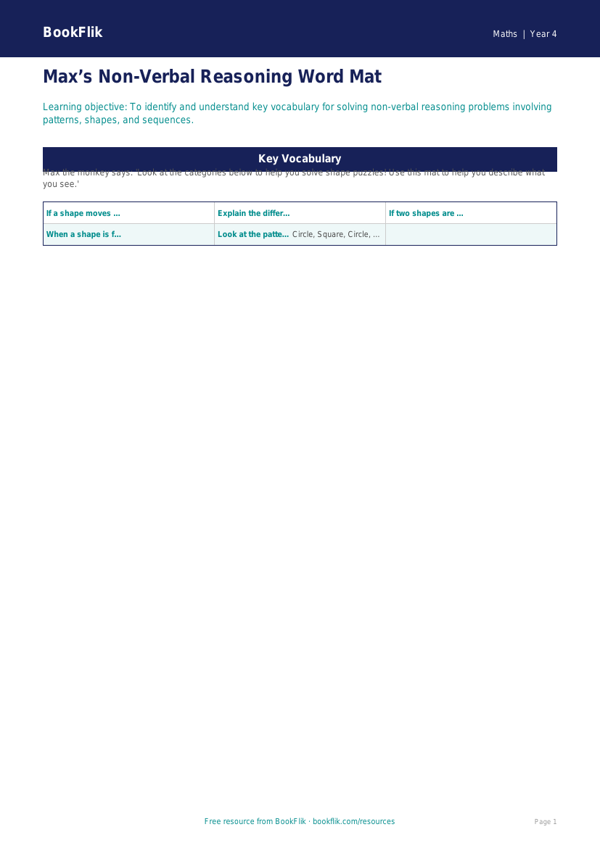
Boost your classroom resources with our free Maths non verbal reasoning word mat year 4 core. Designed specifically for pupils working at the expected standard, this essential tool helps children develop the spatial awareness and logical thinking skills required for success. By focusing on identifying patterns, sequences, and relationships between shapes, this resource provides the perfect foundation for developing advanced problem-solving techniques.
Our Maths non verbal reasoning word mat year 4 core is packed with clear, illustrated examples of common patterns found in reasoning tasks. Children will learn how to identify rotations, reflections, and translations of 2D shapes. They will also practise spotting odd-one-out sequences and completing complex grids. Using this mat, pupils can build their confidence when tackling tricky visual puzzles, helping them to articulate their mathematical thinking using precise vocabulary such as symmetry, clockwise, anticlockwise, and congruent.
Teachers can use this Maths non verbal reasoning word mat year 4 core as a handy desk-side reference during independent work, or as a scaffolded support during small-group interventions. It aligns perfectly with the UK National Curriculum goal of helping children solve problems by applying their mathematical knowledge to a variety of routine and non-routine challenges. Whether you are introducing a new concept or providing a quick refresher, the clear layout ensures that students can navigate different reasoning styles with ease.
This resource is part of our core collection, tailored to meet the needs of Year 4 learners who are secure in their basic geometric understanding. It encourages students to look beyond numbers and explore the logic hidden within patterns. By using this mat, your class will develop the resilience needed to break down visual puzzles into manageable steps. Download this free, high-quality educational tool today to help your students master the art of logical deduction and become more independent, creative thinkers in their maths lessons.
Preview the worksheet
If the preview does not load, open the PDF in a new tab.