
Verbal Reasoning Flashcards Year 4 | Australian Curriculum | BookFlik
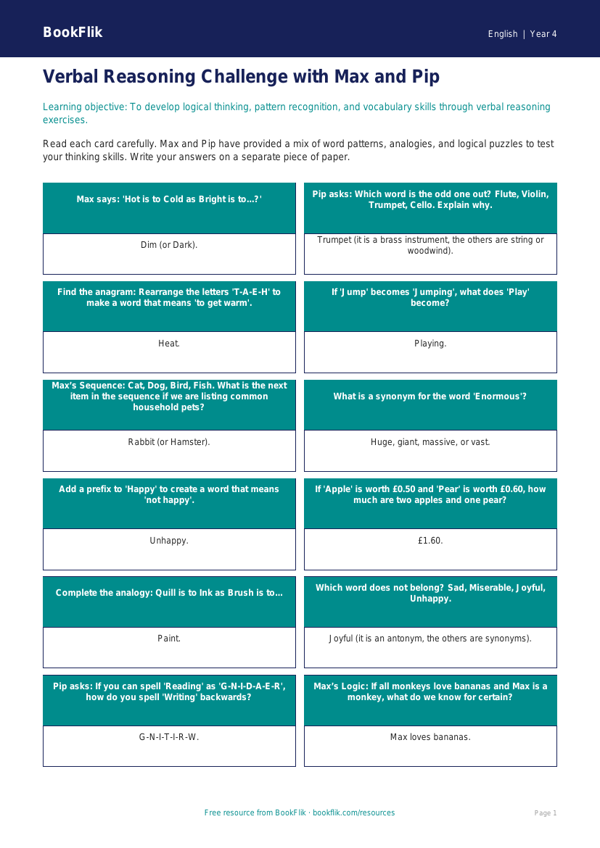
Boost your classroom resources with our exclusive collection of English verbal reasoning flashcards year 4 greater depth. Designed specifically for Year 4 pupils who are exceeding age-related expectations, these challenging flashcards are perfect for stretching young minds and developing sophisticated linguistic agility.
Our resource focuses on high-level verbal reasoning skills, including advanced word analogies, complex letter-pattern sequences, and nuanced synonym and antonym relationships. By engaging with these English verbal reasoning flashcards year 4 greater depth, children will strengthen their logical thinking and vocabulary acquisition. These materials are crafted to align with the Australian Curriculum (ACARA), specifically supporting the development of precise language use, grammatical understanding, and critical thinking skills essential for higher-level literacy.
Teachers can integrate these cards into daily morning starters, small group interventions, or as an enrichment activity for fast finishers. Each card is structured to encourage deep analytical thought, moving beyond basic comprehension to explore the architecture of language. To support the needs of gifted and talented learners, we have included prompts that require children to justify their answers, compare linguistic structures, and explain the logic behind their deductions.
Using these English verbal reasoning flashcards year 4 greater depth allows educators to provide a scaffolded approach to complex reasoning. The set includes eight specific challenge tasks, such as:
1. Explain why a specific word pair represents an antonym relationship.
2. Justify your answer when selecting the odd one out from a complex list.
3. Compare and contrast the root words of two related terms.
4. What might happen if we changed a prefix in this word?
5. Create an original analogy using the pattern provided.
6. Predict the next word in a sequence based on syllable structure.
7. Articulate the logical rule governing a letter-based puzzle.
8. Evaluate the impact of using a synonym versus the original word in a sentence.
Empower your pupils to think critically and express themselves with confidence using this comprehensive, teacher-friendly resource.
Preview the worksheet
If the preview does not load, open the PDF in a new tab.