
Free Classification Keys Drawing Sheet | Grade 3 | Science | BookFlik
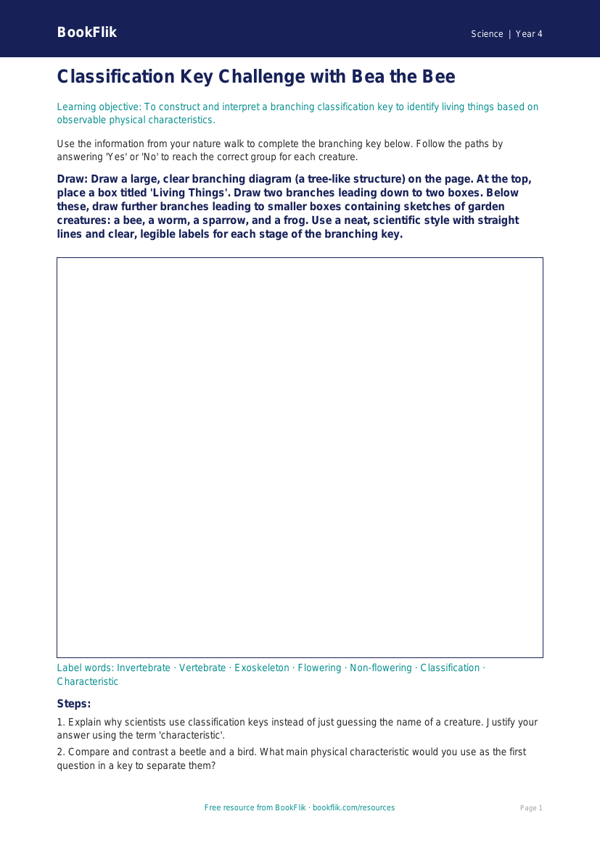
Unlock the mysteries of the natural world with our Science classification keys drawing sheet year 4 greater depth resource. Designed specifically for pupils ready to push beyond standard curriculum expectations, this educational tool helps children master the art of biological classification. By using a structured branching diagram, students will learn how to identify living things based on specific observable characteristics, such as vertebrate versus invertebrate, or habitat preferences.
This Science classification keys drawing sheet year 4 greater depth is fully aligned with the Common Core State Standards, supporting the requirement for children to group, identify, and name living things. Our character, Bea the honeybee, guides learners through the process, encouraging them to think like field biologists. Teachers can use this as an independent challenge or a collaborative task to spark scientific discourse. Because this resource focuses on greater depth, it moves past simple identification and asks students to construct their own complex keys, testing their logical reasoning and attention to detail.
What makes this Science classification keys drawing sheet year 4 greater depth unique is its emphasis on higher-order thinking. Rather than just ticking boxes, pupils are required to justify their classification choices using scientific vocabulary.
The resource includes the following extension questions:
1. Explain why a spider is classified as an invertebrate despite having a hard exoskeleton.
2. Compare and contrast the physical features of a fish and an amphibian.
3. Justify your answer: Does a classification key always need to end with a single species?
4. What might happen if an organism possesses characteristics from two different branches of your key?
5. Design a new classification key for five household items, ensuring each branch asks a clear yes/no question.
6. Evaluate the limitations of using a branching key when discovering a brand-new, unknown species in the rainforest.
Download this free, printable sheet today to inspire your young scientists to categorize, analyze, and discover the diversity of life on Earth.
Preview the worksheet
If the preview does not load, open the PDF in a new tab.