
Free Portraits Template | Year 5 | Art | BookFlik
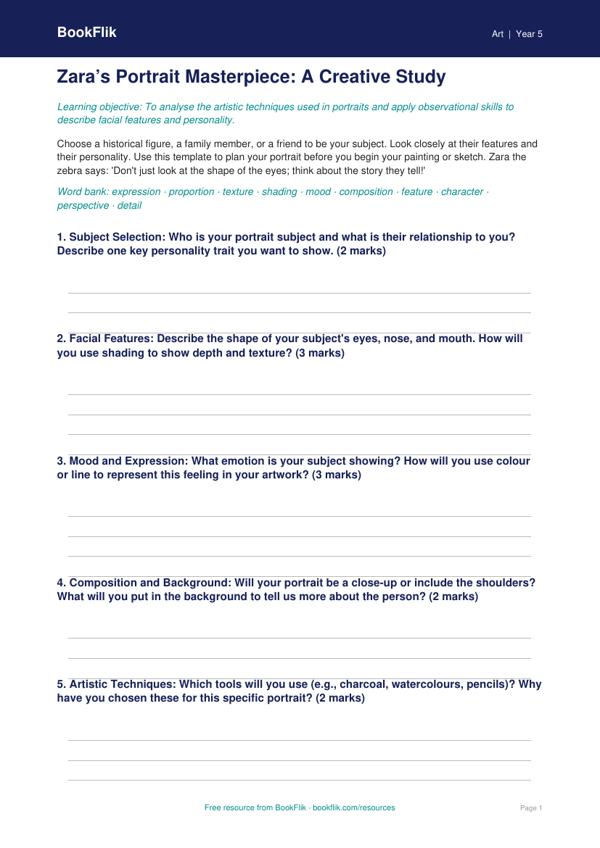
Looking for a creative way to teach portraiture in your classroom? Our Art portraits template year 5 core resource is designed to help students master the intricacies of facial proportions and expression. This comprehensive pack provides everything teachers need to guide pupils through the process of drawing accurate, expressive faces while meeting the requirements of the Australian Curriculum (ACARA) for upper Key Stage 2.
In this lesson, students will explore the work of portrait artists throughout history, learning how to place features such as eyes, noses, and mouths correctly on the page. By using our Art portraits template year 5 core, children will develop their sketching skills, experiment with shading techniques to create depth, and learn how to convey personality through their art. Whether your class is focusing on self-portraits or sketching historical figures, this template provides a structured starting point that encourages individual creativity.
Teachers can use this resource as a standalone activity or as part of a broader study on human form and anatomy. The pack includes step-by-step guides, a vocabulary bank of artistic terms, and a reflection sheet where children can evaluate their own progress. Because this Art portraits template year 5 core is designed for the expected standard, it offers the perfect balance of support and challenge, ensuring all learners can achieve a high-quality outcome.
By downloading this free resource, you gain a versatile tool that aligns perfectly with Art and Design learning objectives, focusing on improving drawing proficiency and refining techniques. It is ideal for busy teachers looking for high-quality, print-ready materials that save time on planning.
Review Questions:
1. Why is it important to consider the placement of eyes when drawing a face?
2. What shading techniques could you use to make a nose look three-dimensional?
3. How can an artist show a specific emotion through a portrait?
4. Why do artists often sketch light guidelines before adding detail?
5. Which facial feature do you find most challenging to draw and why?
Preview the worksheet
If the preview does not load, open the PDF in a new tab.