
Free Sketching Activity Sheet | Foundation | Art | BookFlik
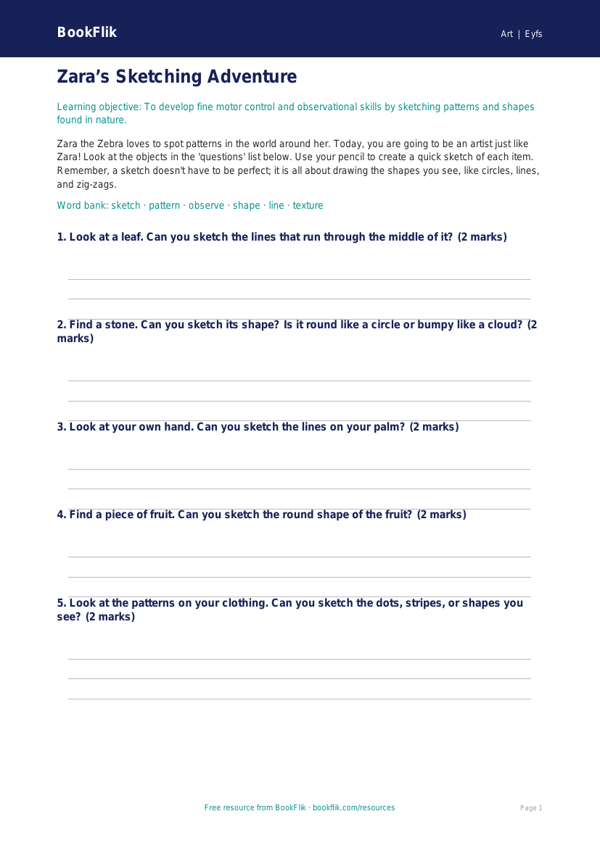
Help your pupils discover the joy of mark-making with our engaging Art sketching activity sheet eyfs core resource. Designed specifically for children aged 3 to 5, this printable sheet invites students to explore the world through the eyes of Zara the zebra, our resident art expert. By focusing on simple observational skills, children will learn how to look closely at shapes, lines, and textures in the natural world, building the foundational motor skills necessary for confident drawing.
This Art sketching activity sheet eyfs core is fully aligned with the Australian Curriculum (ACARA) for Early Years Foundation Stage, specifically supporting Expressive Arts and Design. Teachers can use this resource during outdoor learning sessions or as part of a focused creative area activity. Zara the zebra encourages children to find objects in the classroom or garden—such as a leaf, a stone, or a toy—and attempt to recreate their outlines on paper. This process helps children understand how to translate three-dimensional objects into two-dimensional drawings.
The resource is carefully curated for learners working at the expected standard. It includes a variety of guided tasks that progress from tracing simple patterns to freehand sketching. By using this Art sketching activity sheet eyfs core, educators can foster resilience and patience as children learn that art is a process of trial and error.
To support your lesson planning, we have included 5-7 questions to check understanding:
1. Can you name two different shapes you see on your object?
2. Which pencil mark is darker, the one you press hard or the one you press softly?
3. How does the texture of the object feel in your hand?
4. Can you draw a line that looks like the edge of your leaf?
5. Why is it important to look at your object while you draw?
6. Can you find a pattern on your object to include in your sketch?
Preview the worksheet
If the preview does not load, open the PDF in a new tab.