
Free Algorithms Activity Sheet | Foundation | Computing | BookFlik
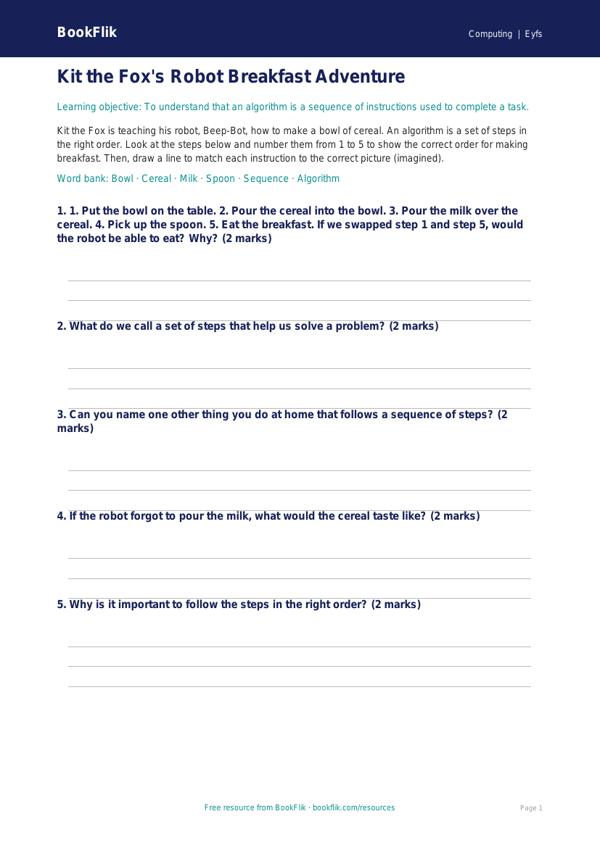
Boost your classroom computing lessons with our engaging and free Computing algorithms activity sheet eyfs core resource. Designed specifically for Reception-aged children, this resource introduces the foundational concept of algorithms as a series of simple, logical steps. By following clear instructions to complete a task, children develop the computational thinking skills necessary to understand how sequences work in the world around them.
In this activity, Kit the fox needs help navigating a path through the forest to find a hidden treasure. Children will use directional language and spatial awareness to create a sequence of moves, turning abstract ideas into a physical path. This Computing algorithms activity sheet eyfs core supports the Australian Curriculum (ACARA) goal of understanding what algorithms are and how they are implemented as programs on digital devices. It encourages children to debug their own work if they take a wrong turn, fostering resilience and logical problem-solving.
Teachers can use this resource as a guided whole-class activity on the interactive whiteboard or as a focused independent task during continuous provision. It is perfect for small group work where children can talk through their steps aloud, reinforcing their understanding of sequencing. As a core-level resource, this sheet is perfectly pitched for learners working at the expected standard, providing just enough challenge to stretch their thinking while remaining accessible.
By downloading this Computing algorithms activity sheet eyfs core, you gain a high-quality, print-ready tool that aligns with the Early Years Foundation Stage framework. It is an excellent way to introduce technical concepts through play, ensuring that every child builds confidence in their computing journey.
Questions for your learners:
1. What is the first step Kit needs to take to move forward?
2. Can you show me the path using your finger?
3. What happens if we change the order of the steps?
4. How do we fix the path if we go the wrong way?
5. Can you write your own set of instructions for a friend to follow?
Preview the worksheet
If the preview does not load, open the PDF in a new tab.