
Coding Quiz Year 4 | Digital Technologies | BookFlik
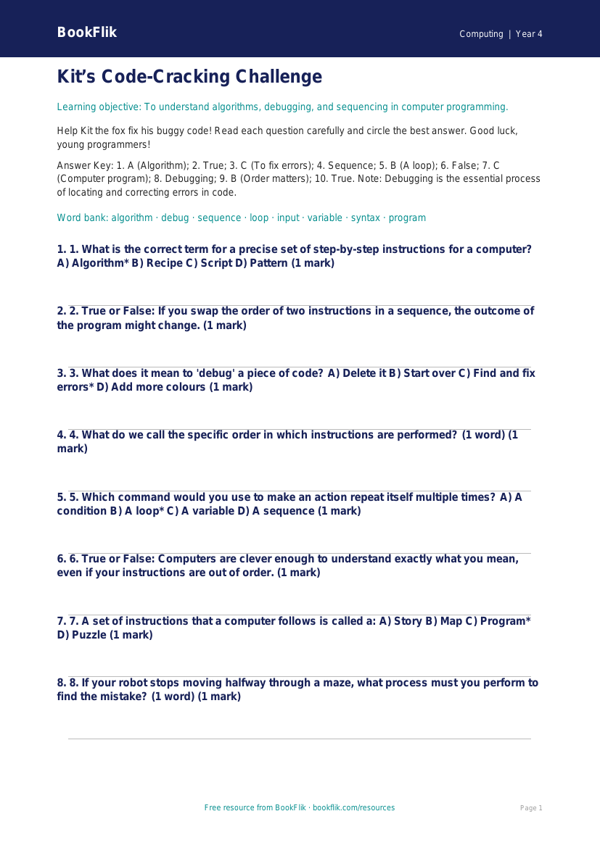
Boost your pupils’ logical thinking with our interactive Computing coding quiz year 4 greater depth resource. Designed specifically for Year 4 classrooms, this engaging activity challenges children to move beyond basic sequencing and explore the complexities of algorithms, debugging, and computational thinking.
In this quiz, Kit the fox guides learners through a series of increasingly difficult puzzles. Students will not simply identify the next step in a sequence; they will be tasked with predicting the output of complex algorithms, identifying subtle errors in code, and justifying why a specific loop structure is more efficient than a repeated command. By engaging with this Computing coding quiz year 4 greater depth, pupils will sharpen their ability to decompose problems and recognise patterns, key skills required for the Australian Curriculum (ACARA).
Teachers can use this resource as a formative assessment tool to identify gifted and talented learners who are ready to progress to more abstract concepts. Whether used as a starter activity to spark discussion or a plenary to consolidate learning, the questions are structured to promote higher-order thinking. Each task encourages pupils to explain why a sequence might fail or compare and contrast different approaches to solving the same computational problem.
This Computing coding quiz year 4 greater depth is perfectly aligned with the Australian Curriculum (ACARA) aim of ensuring pupils can design, write, and debug programs that accomplish specific goals. By focusing on variables, logical reasoning, and precision, the quiz ensures that high-attaining students remain challenged and curious.
The resource includes six to eight multi-layered questions, ranging from “What might happen if we change this variable?” to creative extension tasks that ask pupils to design their own pseudo-code to solve a real-world scenario. Download this set today to foster a classroom environment where computational logic is celebrated, and every child is encouraged to think like a true computer scientist.
Preview the worksheet
If the preview does not load, open the PDF in a new tab.