
Europe Flashcards Year 4 Geography | Greater Depth | BookFlik
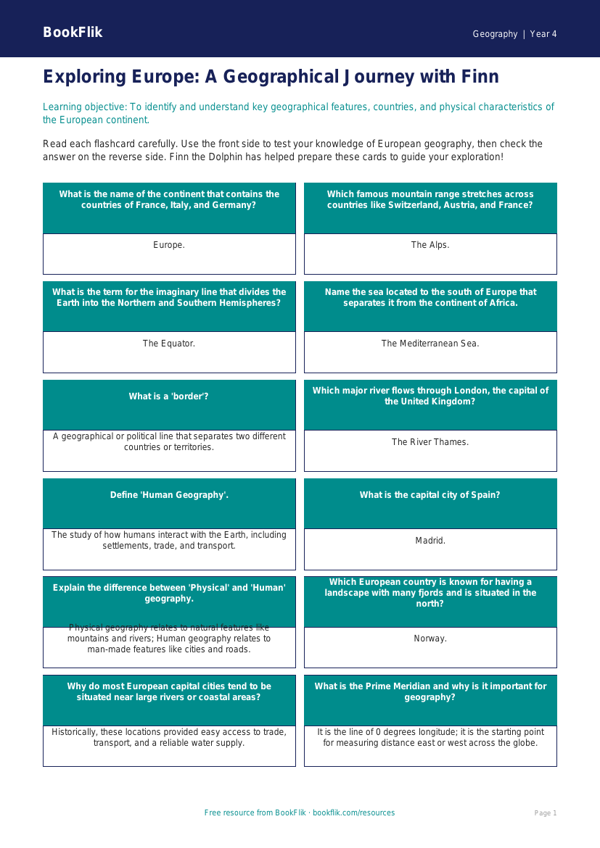
Boost your classroom resources with our premium Geography Europe flashcards year 4 greater depth set, specifically designed to challenge high-achieving pupils. This comprehensive resource helps children master the European continent, moving beyond basic capital cities to explore complex physical and human geography.
These Geography Europe flashcards year 4 greater depth are perfectly aligned with the Australian Curriculum (ACARA) for Key Stage 2. While standard tasks focus on location knowledge, this pack pushes learners to investigate environmental regions, climate zones, and significant mountain ranges such as the Alps and the Pyrenees. By using these Geography Europe flashcards year 4 greater depth, students will develop a sophisticated understanding of how physical landscapes influence human settlement and economic activity across the continent.
Teachers can utilise these cards in various ways: as a springboard for independent research, as prompts for structured classroom debates, or as a tool for collaborative mapping exercises. With Finn the dolphin as your classroom guide, pupils are encouraged to map out trade routes and investigate the impact of rivers on European development.
Each card features a high-order thinking prompt to stretch gifted and talented learners. Instead of simple recall, children are asked to justify their answers, compare and contrast different climate zones, and explain why specific regions have developed unique cultural identities.
The set includes eight challenging questions:
1. Explain why the Alps act as a natural barrier to travel and trade.
2. Compare and contrast the climate of Southern Europe with that of Scandinavia.
3. Justify why the River Danube is considered a vital artery for European commerce.
4. What might happen if a major European mountain range were to suddenly erode?
5. Analyse how proximity to the sea influences the economy of coastal nations.
6. Design a new sustainable tourism plan for a mountainous region.
7. Evaluate the impact of urbanisation on European biodiversity.
8. Create a travel itinerary that crosses three different time zones.
Preview the worksheet
If the preview does not load, open the PDF in a new tab.