
Free Mental Health Word Mat | Year 4 | HASS / Personal Development | BookFlik
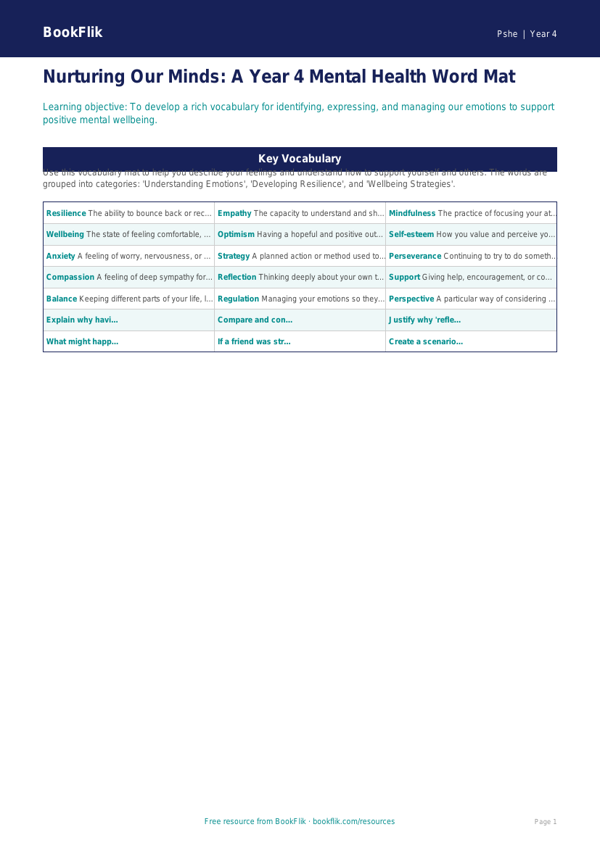
Boost your classroom wellbeing resources with our premium PSHE mental health word mat year 4 greater depth, designed specifically for learners who thrive on complex vocabulary and reflective inquiry. As children progress through Key Stage 2, it is vital they develop the emotional literacy to articulate their inner experiences. This resource moves beyond basic emotions, introducing sophisticated terminology such as resilience, self-regulation, empathy, and perspective-taking to help pupils navigate their social and emotional landscape.
This PSHE mental health word mat year 4 greater depth is fully aligned with the Australian Curriculum (ACARA) requirements for Relationships and Health Education. By providing a structured bank of nuanced adjectives and abstract nouns, it empowers students to move away from simplistic descriptions of feelings, encouraging them to identify the subtle shades of their mental wellbeing. Teachers can utilise this resource during morning check-ins, as a scaffold for creative writing, or as a prompt for class discussions regarding personal growth and emotional intelligence.
What truly sets this resource apart is the focus on higher-order thinking. We have integrated a section that challenges gifted and talented learners to justify their emotional responses and compare different viewpoints. Through our PSHE mental health word mat year 4 greater depth, pupils are prompted to consider the impact of their actions on others and explore the concept of a growth mindset in challenging situations.
The mat includes a selection of six challenging questions, such as: Explain why active listening is a vital component of healthy friendships? Compare and contrast the feeling of being nervous with the feeling of being excited; what physiological similarities do they share? Justify your answer when asked why it is important to express gratitude during difficult times. This resource is an essential tool for fostering a compassionate, articulate, and self-aware classroom environment where every child feels confident to express their thoughts clearly.
Preview the worksheet
If the preview does not load, open the PDF in a new tab.