
Free Relationships Template | Foundation | HASS / Personal Development | BookFlik
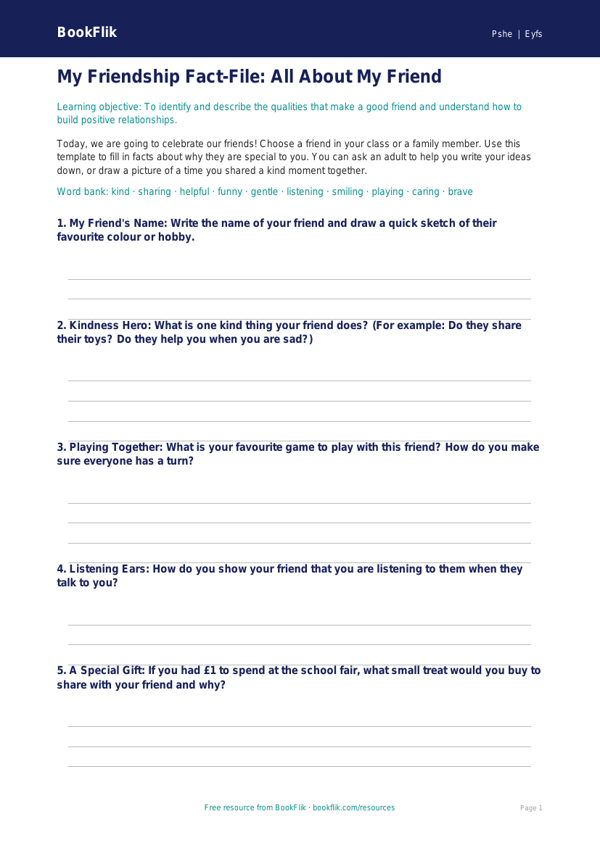
Boost your classroom social skills with our high-quality HASS / Personal Development relationships template eyfs core resource. Designed specifically for Early Years practitioners, this free pack helps children aged 3-5 explore the fundamentals of friendship, kindness, and emotional awareness. By using our original character Max the Monkey, who loves solving maths puzzles, children will learn how to identify feelings and understand the importance of sharing.
Our HASS / Personal Development relationships template eyfs core supports the Statutory Framework for the Early Years Foundation Stage, specifically focusing on Personal, Social and Emotional Development. Through structured activities, children will learn to recognise how their actions affect others, how to take turns, and how to express their emotions clearly. This resource encourages pupils to work collaboratively, fostering a positive classroom environment where every child feels valued.
Teachers can use this HASS / Personal Development relationships template eyfs core as a standalone lesson plan or as part of a continuous provision set-up. The template includes prompts for circle time, role-play scenarios involving our friendly characters, and reflection sheets to track progress. Because this is designed at the expected standard, it provides the perfect balance of challenge and support for learners working within the Early Years milestones. Whether you are leading a whole-class discussion or working in small groups, these materials make planning seamless and effective.
The resource includes 5-7 engaging questions to deepen understanding:
1. How does Max feel when he shares his banana with his friends?
2. Can you show me a happy face and a sad face?
3. If a friend is feeling lonely, what is one kind thing you could do?
4. Why is it important to take turns when playing a game?
5. Can you think of a time you helped someone today?
6. How do we show our friends that we are listening to them?
7. What makes a good friend?
Download this essential toolkit today to inspire kindness and build strong, healthy relationships in your classroom.
Preview the worksheet
If the preview does not load, open the PDF in a new tab.