
Free Magnets Word Mat | Year 3 | Science | BookFlik
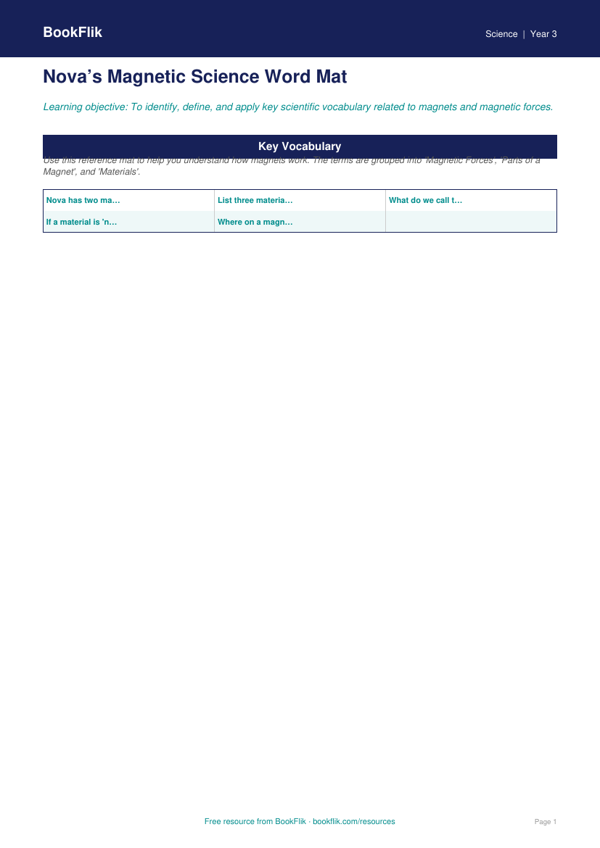
Help your pupils master the mysteries of forces with our engaging Science magnets word mat year 3 core resource. Designed specifically for the Australian Curriculum (ACARA), this colourful and clear visual aid is the perfect tool to support Year 3 learners as they explore the fascinating world of magnetism.
Inside this Science magnets word mat year 3 core, children will discover essential scientific vocabulary, including terms like magnetic, non-magnetic, attract, repel, poles, and force. By providing these keywords alongside helpful illustrations, this resource builds confidence and helps students articulate their findings during practical experiments. Whether they are testing everyday objects in the classroom to see which are attracted to magnets or learning about the invisible forces at work, this mat serves as a reliable desk-side companion.
Teachers can use this Science magnets word mat year 3 core as a prompt during whole-class discussions, a reference guide for independent writing tasks, or a support tool during hands-on investigation stations. It is perfectly aligned with the Year 3 programme of study, which requires pupils to compare how things move on different surfaces and notice that some forces need contact whereas magnetic forces can act at a distance.
This resource is pitched at the core expected standard for Year 3, ensuring that all pupils have access to the terminology they need to succeed in their science lessons.
Check your understanding with these questions:
1. What is the name of the two ends of a magnet?
2. If two magnets push each other away, do they attract or repel?
3. Name two common materials that are magnetic.
4. If you have a toy car costing £2.50 and a magnet costing £1.20, what is the total?
5. Why do we use the term non-magnetic for some objects?
6. Can a magnet work through a piece of paper? Explain your answer.
Preview the worksheet
If the preview does not load, open the PDF in a new tab.