
Free Skeleton And Muscles Writing Frame | Year 3 | Science | BookFlik
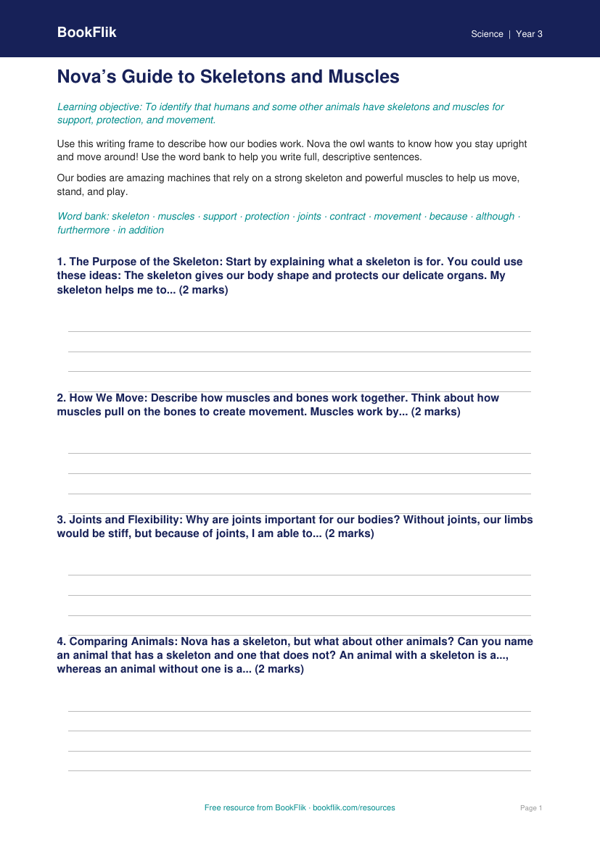
Boost your classroom science lessons with our free Science skeleton and muscles writing frame year 3 core resource. Designed specifically for Year 3 learners, this printable aid helps pupils articulate their understanding of the human body with confidence and clarity.
At this stage of the curriculum, children are expected to identify that humans and some other animals have skeletons and muscles for support, protection, and movement. This Science skeleton and muscles writing frame year 3 core provides a structured layout that guides students through these core concepts. By using clear headings and scaffolded sentence starters, pupils are encouraged to explain the vital role of the skeleton, identify the difference between a vertebrate and an invertebrate, and describe how muscles work in pairs to create movement.
Teachers can use this resource as a concluding task after a practical investigation or as a formative assessment tool to check prior knowledge. The layout is perfect for independent work, allowing children to organise their thoughts before writing their final explanations. Because this Science skeleton and muscles writing frame year 3 core is designed at the expected standard, it supports pupils in using key scientific vocabulary, such as joints, protection, and support, correctly within their sentences.
Aligned with the Australian Curriculum (ACARA) for science, this resource ensures your lesson objectives are met effectively while helping pupils develop their literacy skills alongside their scientific enquiry. Whether you are teaching a unit on animals including humans or focusing on healthy lifestyles, this writing frame is an essential addition to your teaching toolkit. It is clean, accessible, and ready to print for your next lesson. Download this Science skeleton and muscles writing frame year 3 core today to help your class master the foundations of biology through structured, supported writing that builds academic confidence and encourages scientific curiosity in every young learner.
Preview the worksheet
If the preview does not load, open the PDF in a new tab.