
Free Pattern Template | Class 4 | Art | BookFlik
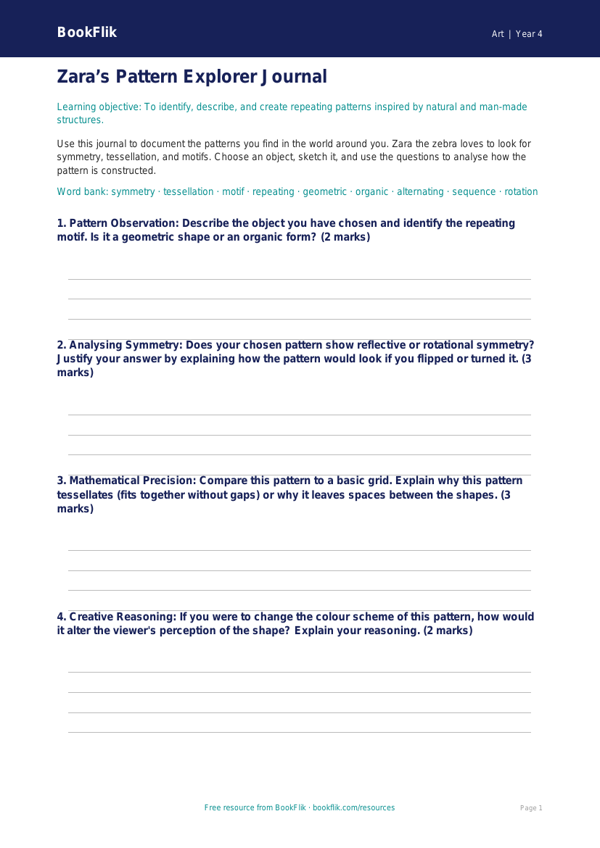
Unlock your pupils’ creative potential with our exclusive Art pattern template year 4 greater depth resource. Designed specifically to support the CBSE / NCERT Curriculum goal of improving mastery of art and design techniques, this pack encourages children to explore intricate geometric shapes, tessellation, and organic motifs. Zara the zebra, our artistic guide, introduces the concept of symmetry and repetition, challenging students to move beyond basic patterns and experiment with complex, overlapping designs.
This resource is an essential tool for educators looking to stretch gifted and talented learners. By using our Art pattern template year 4 greater depth pack, teachers can provide a structured yet open-ended environment where students must analyse how cultural patterns, such as those found in Islamic art or ancient mosaics, are constructed. The template provides a starting point for mathematical precision, requiring pupils to calculate angles and rotations to ensure their patterns repeat seamlessly across a surface.
To achieve greater depth, the activities go beyond simple decoration. Students are prompted to evaluate their colour palettes, justify their choice of medium, and explain the visual rhythm created by their designs. The Art pattern template year 4 greater depth materials are perfect for mixed-ability classrooms, offering core tasks for all pupils while providing the intellectual rigour required for those exceeding expectations.
Included in this download:
1. A foundational grid template for exploring tessellation.
2. A guide to symmetry, reflection, and rotation.
3. Six high-level discussion prompts, such as: Explain why specific colours enhance the focal point of your pattern. Compare and contrast organic patterns found in nature with geometric patterns in architecture. Justify your decision to use either a warm or cool colour scheme to evoke a specific mood. What might happen if you altered the scale of your repeating unit? How would you adapt this design for a three-dimensional surface? Create a new, original pattern that represents a scientific concept, such as the life cycle of a plant.
Preview the worksheet
If the preview does not load, open the PDF in a new tab.