
Free Programming Word Mat | Class 4 | Computing | BookFlik
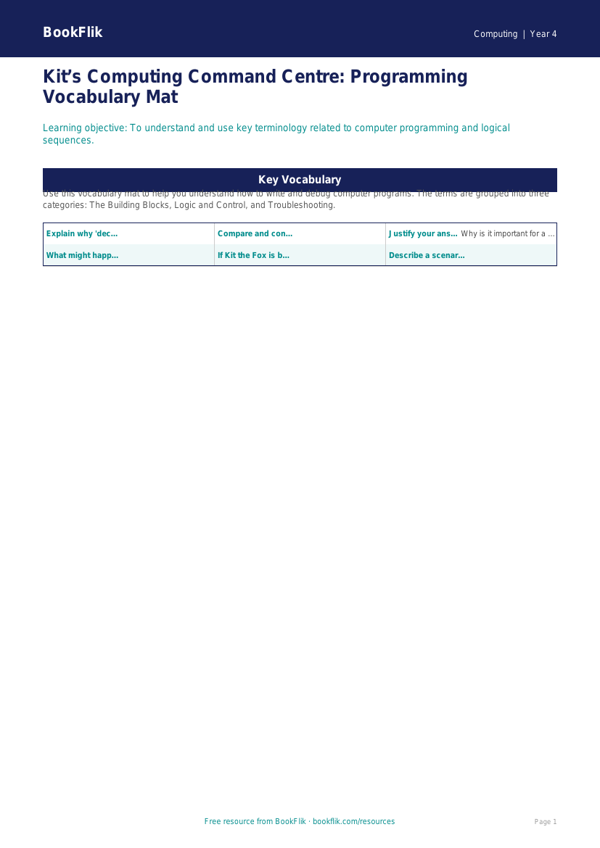
Boost your classroom’s digital literacy with our comprehensive Computing programming word mat year 4 greater depth resource. Designed specifically for ambitious learners in Key Stage 2, this educational tool moves beyond basic definitions to introduce the sophisticated terminology required to master block-based coding environments and early text-based languages.
As pupils progress through the CBSE / NCERT Curriculum, they are expected to design, write, and debug programs that accomplish specific goals. This Computing programming word mat year 4 greater depth provides the essential vocabulary to help children articulate their logic. Inside, you will find advanced terms such as algorithmic decomposition, Boolean logic, conditional statements, and iterative loops. By mastering this technical lexicon, students can transition from simple sequence-based tasks to complex projects involving variable manipulation and event-driven programming.
Teachers can use this resource as a permanent desk reference during coding sessions or as a challenge-based display for independent work. It is perfectly suited for gifted and talented learners who are ready to explore the theoretical side of computer science. The mat includes a dedicated section for debugging strategies, encouraging children to think critically about code efficiency and structure.
Whether you are teaching students how to create interactive animations or guiding them through the creation of complex games, this Computing programming word mat year 4 greater depth will empower your class to justify their design choices. The resource includes six higher-order thinking questions designed to stretch their understanding:
1. Explain why it is important to decompose a large problem into smaller, manageable sub-tasks.
2. Compare and contrast the function of a ‘repeat’ loop versus a ‘while’ loop.
3. Justify your answer: Why is debugging considered a creative process?
4. What might happen if a variable is not initialised at the start of a program?
5. How does using conditional logic change the outcome of a user-controlled simulation?
6. Design a new algorithm for a simple task and identify one potential point of failure.
Download this resource today to support your pupils in achieving greater depth in their computing journey.
Preview the worksheet
If the preview does not load, open the PDF in a new tab.