
Free Prototyping Activity Sheet for Class 4 CBSE Students | BookFlik
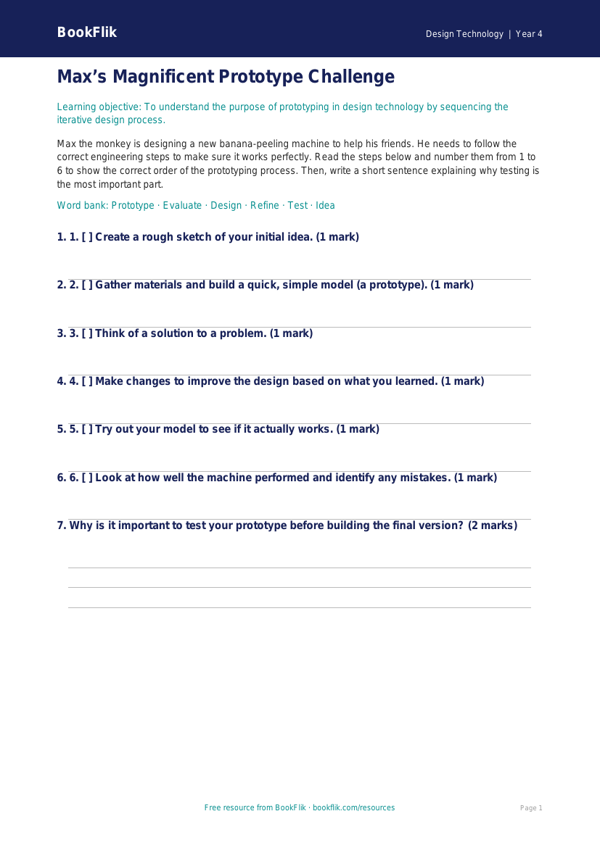
Boost your classroom creativity with our Design Technology prototyping activity sheet year 4 core resource. This engaging, free printable is designed specifically for Class 4 pupils to explore the iterative design process in a fun and hands-on way.
In this lesson, Max the monkey has a challenge: he needs to design a sturdy bridge for his forest friends using only recycled materials. By working through this Design Technology prototyping activity sheet year 4 core, children will learn how to turn their initial sketches into 3D models. They will discover why testing is a vital part of the design process, learning how to evaluate their creations, identify potential weaknesses, and make improvements to their structures. This helps pupils understand that making mistakes is a natural and important step in successful engineering.
Teachers can use this resource as a standalone lesson or as part of a larger unit on structures. The sheet guides students through the stages of researching, designing, building, and evaluating their prototypes. It is perfectly aligned with the CBSE / NCERT Curriculum for Design Technology, focusing on selecting tools and materials, measuring accurately, and refining ideas based on testing results.
This specific Design Technology prototyping activity sheet year 4 core is set at the expected standard for Class 4 learners. It encourages independent thinking while providing enough structure to ensure every child feels confident in their design journey.
The pack includes:
1. A design brief outlining the construction challenge.
2. A planning template for sketching ideas and listing materials.
3. A testing log to record how the prototype performs under a weight test.
4. A reflection section to consider what worked well and what could be improved.
5. A final evaluation table to compare their project against original goals.
6. A self-assessment checklist.
Download this resource today to help your class think like real engineers while developing essential skills in problem-solving, resilience, and creative thinking.
Preview the worksheet
If the preview does not load, open the PDF in a new tab.