
Free Punctuation Word Mat | Nursery / LKG | English | BookFlik
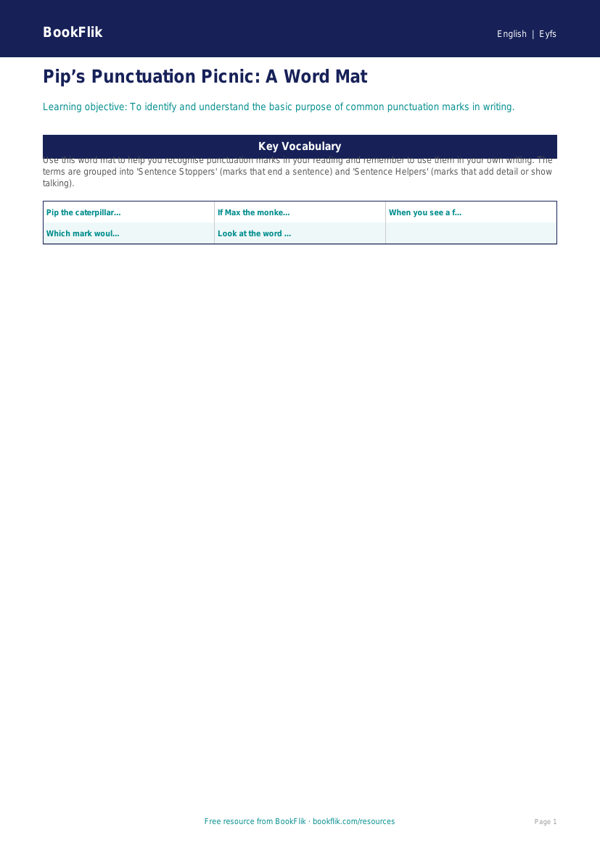
Support your pupils’ early writing journey with our beautifully illustrated English punctuation word mat eyfs core resource. Designed specifically for children aged 3 to 5, this handy mat introduces the building blocks of sentence structure in a way that is engaging and accessible. Featuring our friendly BookFlik character, Pip the caterpillar, this resource helps children recognise and name essential punctuation marks including capital letters, full stops, and question marks.
By using this English punctuation word mat eyfs core, children will develop their confidence in identifying where sentences begin and end. The mat provides clear visual examples alongside simple definitions, helping learners understand that a capital letter starts a sentence and a full stop finishes it. This is perfectly aligned with the CBSE / NCERT Curriculum goal of encouraging children to write simple sentences that can be read by themselves and others.
Teachers can use this resource during guided writing sessions, continuous provision, or as a reference tool on writing tables. It is ideal for children working at the expected standard, providing a gentle prompt to help them apply their knowledge of punctuation independently. Whether you are modelling a sentence on the whiteboard or supporting a small group, this English punctuation word mat eyfs core acts as a consistent visual aid to reinforce learning throughout the term.
To check understanding, try these questions with your class:
1. Can you point to the full stop on the mat?
2. Which punctuation mark do we use when we want to ask someone something?
3. What do we always need at the very beginning of a sentence?
4. Can you find the mark that tells us to stop reading for a moment?
5. Why is it important to use a capital letter for a name?
6. If Pip writes a story, which punctuation mark should he use to finish his sentence?
7. Can you spot a punctuation mark that looks like a little dot?
Preview the worksheet
If the preview does not load, open the PDF in a new tab.