
Non-Verbal Reasoning Practice for Class 6 | CBSE Maths | BookFlik
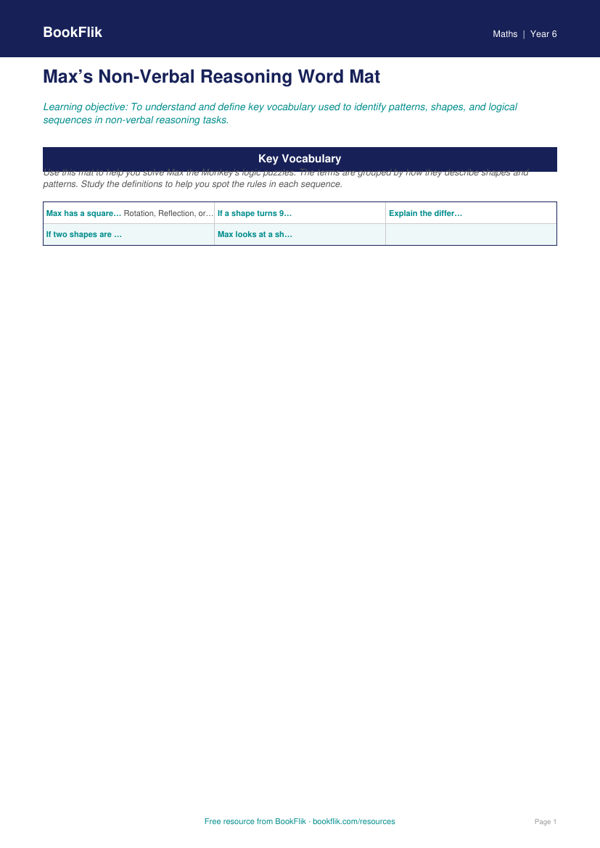
Boost your classroom resources with our comprehensive Maths non verbal reasoning word mat year 6 core. Designed specifically for pupils working at the expected standard, this essential tool helps children master the visual and spatial language required for assessment success. Non-verbal reasoning is a vital skill that encourages logical thinking, pattern recognition, and systematic problem-solving, all of which are key components of the CBSE / NCERT Curriculum.
Our Maths non verbal reasoning word mat year 6 core provides a clear, visual reference for complex concepts. It includes definitions and examples of sequences, rotations, reflections, and 3D shape manipulations. By using this mat, children can quickly identify terminology such as clockwise, anti-clockwise, symmetry, and translation. This resource is perfect for independent work, small group rotations, or as a supportive scaffold during tricky reasoning tasks. Teachers can print these as handy desk mats or display them on working walls to ensure pupils have instant access to the vocabulary they need to articulate their mathematical logic.
This resource is differentiated for the Class 6 core level, ensuring that the terminology and examples are perfectly pitched for learners meeting age-related expectations. It removes the barrier of language, allowing children to focus entirely on the spatial puzzles at hand. By integrating this Maths non verbal reasoning word mat year 6 core into your weekly lessons, you will help your students develop the confidence to tackle complex shapes and patterns with ease.
Each pack includes 7 targeted questions to check understanding:
1. Define a 90-degree clockwise rotation.
2. What is the difference between a reflection and a rotation?
3. Identify the pattern rule in a given sequence of shapes.
4. Explain the term symmetry in relation to 2D polygons.
5. How does a net form a 3D cube?
6. Describe a translation using coordinate language.
7. Use the mat to predict the next shape in a complex series.
Preview the worksheet
If the preview does not load, open the PDF in a new tab.