
Music Notation Template for Class 4 | CBSE Music Resources | BookFlik
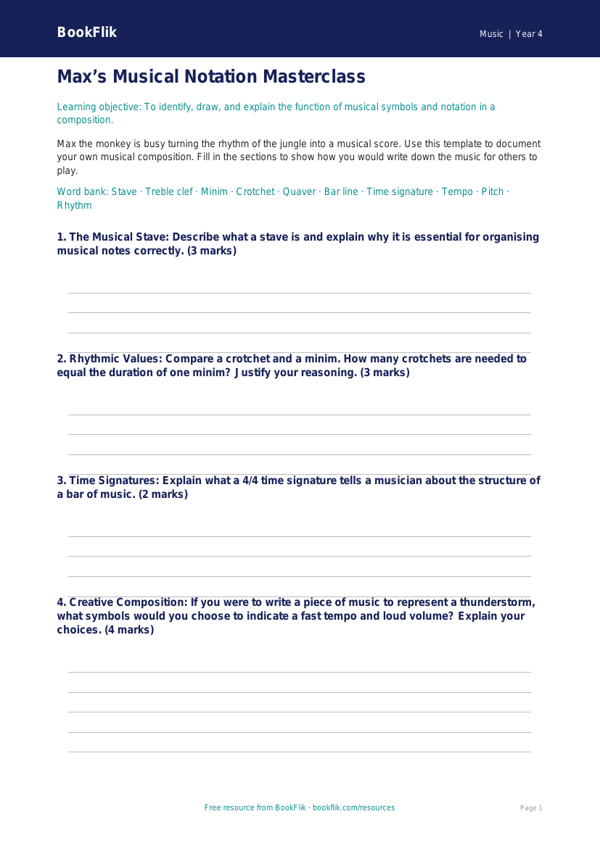
Unlock the potential of your young musicians with our comprehensive Music notation template year 4 greater depth resource. Designed specifically to challenge learners exceeding age-related expectations, this pack moves beyond basic crotchets and quavers, encouraging pupils to explore complex rhythmic patterns, time signatures, and expressive markings.
In line with the CBSE / NCERT Curriculum for Class 4, this resource supports the requirement to improvise and compose music for a range of purposes. By using our Music notation template year 4 greater depth, students will learn to transcribe their own melodies onto stave paper, experiment with tempo markings, and incorporate dynamic symbols such as crescendo and decrescendo. This is an ideal tool for teachers seeking to provide high-quality, structured extension activities that foster both creativity and technical accuracy in the classroom.
The resource is carefully differentiated to ensure that high-achieving pupils are consistently pushed. While the standard template helps children map simple sequences, the greater depth section includes higher-order thinking tasks. For example, students are asked to justify their choice of time signature, explain why a specific tempo marking changes the mood of their composition, and compare how different rhythmic structures influence the overall texture of a piece.
Teachers can use this versatile Music notation template year 4 greater depth as a standalone challenge during composition units or as a continuous provision activity for early finishers. Whether your pupils are writing a fanfare for a lion or a lullaby for a gentle elephant, this resource provides the scaffolding necessary for sophisticated musical expression. Included are six rigorous questions that prompt pupils to evaluate their work, such as: What might happen if you changed the time signature from 4/4 to 3/4? How does your use of dynamics reflect the story you are telling through sound? Justify why you chose specific note lengths to create a sense of urgency. Empower your students to compose with confidence and clarity today.
Preview the worksheet
If the preview does not load, open the PDF in a new tab.