
Rhythm and Beat Music Lesson | Class 4 | CBSE Resource | BookFlik
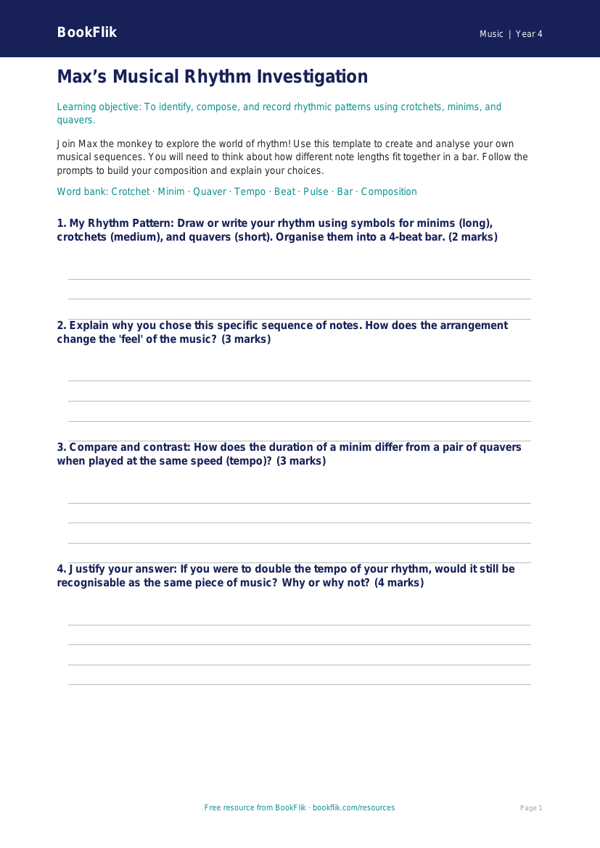
Mastering the building blocks of musical notation is a vital skill for pupils in Key Stage 2. This comprehensive Music rhythm template year 4 greater depth resource is designed to stretch your most capable learners by moving beyond basic beats into the realms of complex syncopation and polyrhythmic structures.
Aligned with the CBSE / NCERT Curriculum, this template encourages children to compose, perform, and evaluate their own rhythmic sequences. Pupils will explore time signatures, including 3/4 and 4/4, while experimenting with rests and varying note values such as quavers, crotchets, and minims. By using this Music rhythm template year 4 greater depth, students will develop a sophisticated understanding of how pulse and tempo interact to create musical tension and resolution.
Teachers can utilise this resource to facilitate small-group workshops or as an independent extension task for gifted and talented learners. The template provides a clear framework for students to transcribe their own patterns, allowing them to explore how different rhythmic combinations can change the character of a piece. Because this Music rhythm template year 4 greater depth is specifically engineered for higher-attaining pupils, it includes advanced challenges that require them to justify their creative choices and analyse the mathematical structure behind their compositions.
The resource includes six thought-provoking questions, such as: Explain why changing the position of a rest alters the ‘feel’ of a rhythm. Compare and contrast the effect of a syncopated beat versus a steady, marching pulse. Justify your answer when choosing an appropriate time signature for a piece inspired by a stormy sea. What might happen if you layered two different time signatures simultaneously? These open-ended tasks ensure that learners are not just following instructions, but are actively engaging in the theoretical and creative processes of music composition. Download this essential tool today to inspire your young musicians to reach their full potential.
Preview the worksheet
If the preview does not load, open the PDF in a new tab.