
Free Properties Of Materials Word Mat | Class 6 | Science | BookFlik
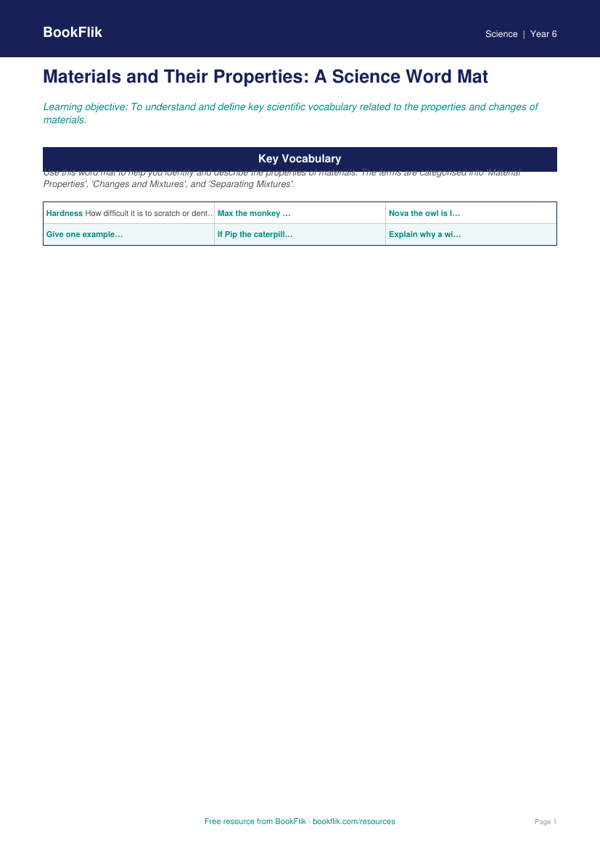
Are you looking for a high-quality classroom resource to support your pupils with their chemistry topics? Our free Science properties of materials word mat year 6 core is the perfect tool to help students master essential scientific vocabulary. Designed specifically for the CBSE / NCERT Curriculum, this resource ensures children can confidently describe and compare the physical characteristics of various substances during their experiments.
By using this Science properties of materials word mat year 6 core, pupils will explore key concepts such as solubility, transparency, conductivity, and magnetism. They will learn how to identify materials that are opaque, translucent, or transparent, and understand the difference between reversible and irreversible changes. This resource is ideal for independent work, group investigations, or as a handy reference guide during written assessments. Teachers can laminate these mats for long-term use in the science lab or print them as a quick-start support sheet for learners who need a confidence boost when articulating their findings.
Our Science properties of materials word mat year 6 core is specifically differentiated for the expected standard of Class 6 pupils. It features clear, age-appropriate definitions alongside helpful illustrations to reinforce learning. Whether your class is conducting a fair test on thermal insulators or investigating the best materials for a waterproof structure, this word mat provides the precise terminology required to achieve higher-level marks.
To check understanding, we have included five challenge questions at the bottom of the resource:
1. Define the term soluble and provide one example of a solid that dissolves in water.
2. If you were designing a window, would you choose an opaque or transparent material? Explain why.
3. Why is metal often used to make kitchen pans?
4. Give an example of an irreversible change.
5. How can you separate a mixture of sand and water?
Download this essential resource today to bring scientific clarity to your classroom!
Preview the worksheet
If the preview does not load, open the PDF in a new tab.