
Free Abstract Art Word Mat | Year 5 Greater Depth | BookFlik
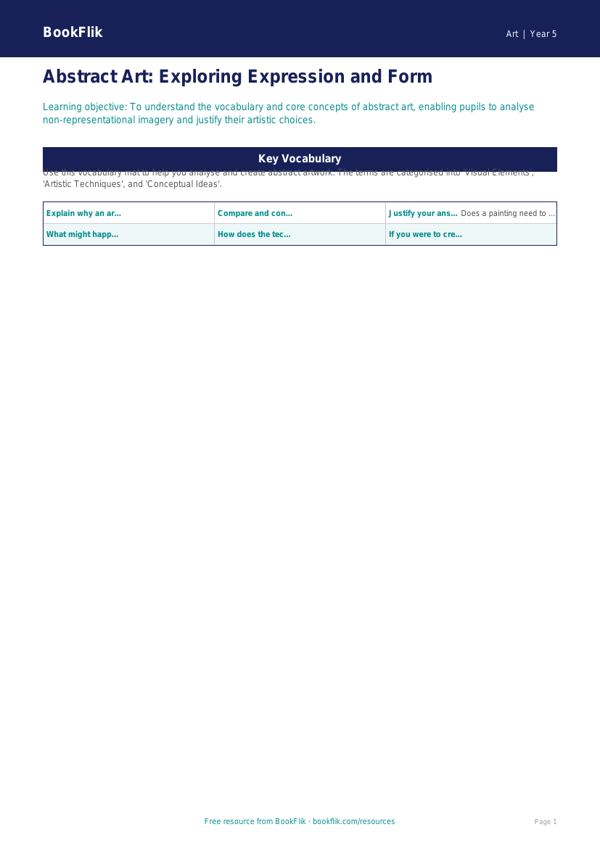
Enhance your classroom displays and inspire creative expression with our comprehensive Art abstract art word mat year 5 greater depth resource. Designed specifically for Key Stage 2, this high-quality learning tool helps pupils move beyond simple descriptions and engage with the complex vocabulary required to analyse and create non-representational works.
This Art abstract art word mat year 5 greater depth resource is perfectly aligned with the UK National Curriculum, which encourages pupils to develop their techniques, including their control and their use of materials, with creativity, experimentation, and an increasing awareness of different kinds of art. The mat provides a sophisticated lexicon, including terms such as juxtaposition, non-objective, monochromatic, organic shapes, and emotional resonance. By using this, children can articulate why an artist might choose specific colours or textures to evoke a particular mood, fostering a deeper understanding of artistic intent.
Teachers can use this resource during independent studio time or as a prompt for group critiques. It serves as an excellent scaffold for pupils who need to refine their evaluative writing, allowing them to justify their aesthetic choices with precision. Because this Art abstract art word mat year 5 greater depth is designed for gifted and talented learners, it includes prompts that encourage higher-order thinking, such as exploring the relationship between geometric patterns and human emotion.
The resource includes eight challenging tasks:
1. Explain why an artist might choose to omit recognisable objects from a composition.
2. Compare and contrast the use of colour in two distinct abstract pieces.
3. Justify your use of line and form in your latest sketchbook entry using technical terminology.
4. What might happen if you changed a monochromatic palette to a warm, vibrant one?
5. Critique a peer’s work using the provided vocabulary.
6. Analyse how texture influences the viewer’s emotional response.
7. Create an original artwork that represents a sound rather than a sight.
8. Design a geometric pattern that conveys the feeling of movement.
Preview the worksheet
If the preview does not load, open the PDF in a new tab.