
Free Kandinsky Flashcards | Year 5 Greater Depth | BookFlik
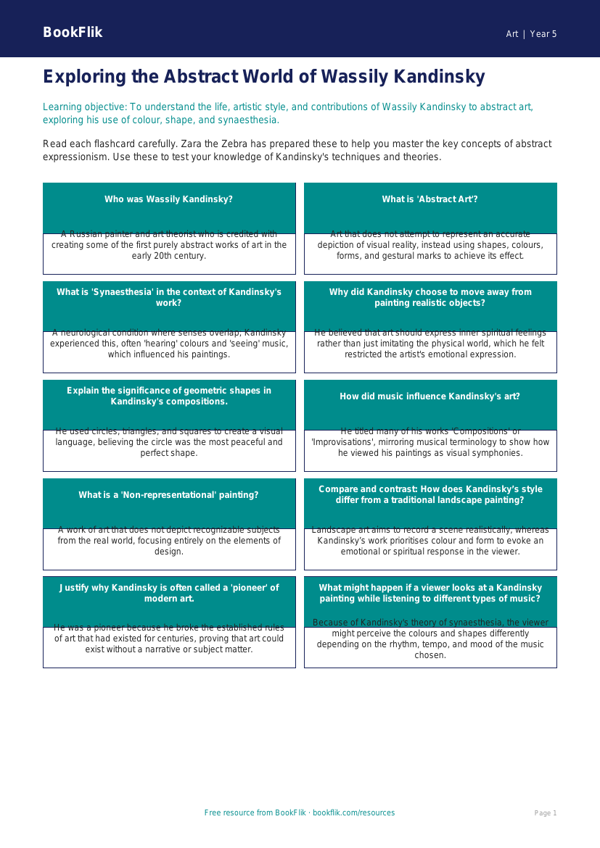
Unlock the vibrant world of abstract expressionism with our bespoke educational resource. Designed specifically for ambitious learners, our Art kandinsky flashcards year 5 greater depth set invites pupils to explore the revolutionary techniques of Wassily Kandinsky. By investigating the synesthetic relationship between colour, shape, and sound, children will develop a profound understanding of how non-representational art can evoke powerful emotional responses.
These Art kandinsky flashcards year 5 greater depth materials are perfectly aligned with the UK National Curriculum for Key Stage 2. They encourage students to move beyond basic observation, prompting them to analyse composition, geometric precision, and the evolution of modern art. Teachers can utilise these cards as a springboard for classroom discussions, visual literacy starters, or as a scaffold for independent research projects. Each card features a high-quality reproduction of a masterpiece, paired with rigorous tasks that challenge students to justify artistic choices and compare Kandinsky’s early figurative work with his later, purely abstract compositions.
We have ensured these Art kandinsky flashcards year 5 greater depth resources provide the necessary stretch for gifted and talented pupils. The set includes eight higher-order thinking questions designed to provoke critical enquiry. Learners will be asked to explain why Kandinsky believed colours possessed specific spiritual vibrations, justify the use of specific shapes within a composition, and predict how the artist might translate a piece of classical music into a visual painting.
This pack fosters a deeper appreciation of art history while honing the analytical vocabulary essential for Year 5 success. Whether used in an art studio setting or as a home-learning enrichment activity, these flashcards provide a structured yet creative gateway into the life and work of a pioneer of abstract art. Download today to inspire your young artists to think like curators, historians, and masters of their own visual language.
Preview the worksheet
If the preview does not load, open the PDF in a new tab.