
Free Pattern Assessment | Year 3 Core | BookFlik
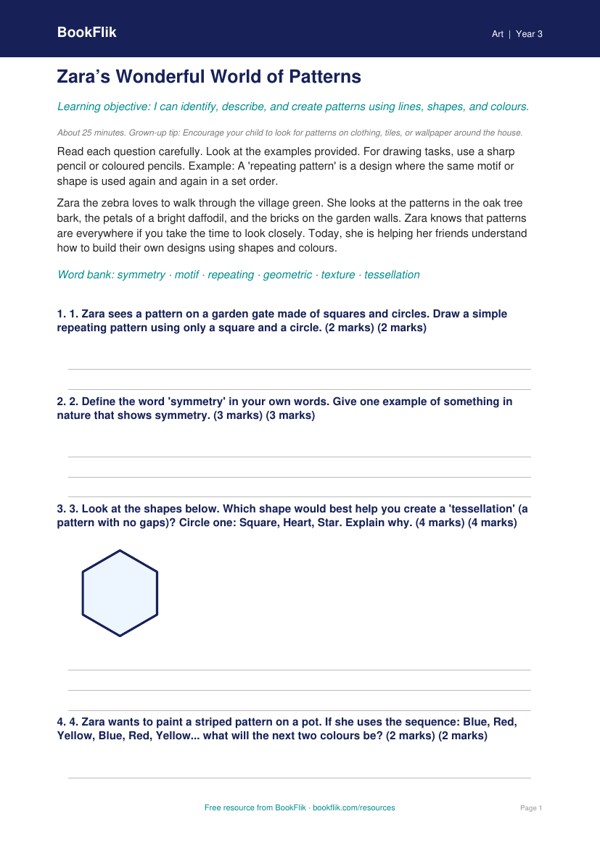
Unlock your students’ creative potential with our comprehensive Art pattern assessment year 3 core resource. Designed specifically for the UK National Curriculum, this engaging activity helps children explore the world of shapes, colours, and repeating designs. Our friend Zara the zebra loves finding patterns in nature and the classroom, and she is ready to guide your pupils through this colourful journey.
This Art pattern assessment year 3 core is perfect for teachers planning their Key Stage 2 lessons or parents looking to support their child’s learning at home. The resource focuses on identifying, describing, and creating patterns, building essential skills for the Year 3 art and design programme of study. Children will look at examples in nature, such as the stripes on a badger or the petals of a spring daffodil, to understand how artists use repetition to create visual interest.
Teachers can use this assessment to gauge understanding at the start or end of a topic. It is carefully differentiated for the core level, ensuring it meets the expected standard for seven and eight-year-olds. The tasks are clear, accessible, and encourage children to apply their knowledge by drawing their own geometric and organic patterns. By using this Art pattern assessment year 3 core, you can provide a structured way for pupils to demonstrate their progress while keeping the experience fun and rewarding.
The pack includes a variety of questions that range from simple recall to creative application, ensuring every child feels confident. For fast finishers, we have included an extra challenge that invites them to design a tile pattern for a local shop or a repeating print for a school uniform. Download this free resource today to bring the beauty of pattern into your classroom or living room, helping every child find their inner artist with Zara.
How to use this assessment
- Time: about 25 minutes
- At home: Encourage your child to look for patterns on clothing, tiles, or wallpaper around the house.
- In the classroom: Focus on the use of correct art vocabulary when evaluating the children’s written explanations.
Preview the worksheet
If the preview does not load, open the PDF in a new tab.