
Free Pattern Worksheet | Year 3 Core | BookFlik
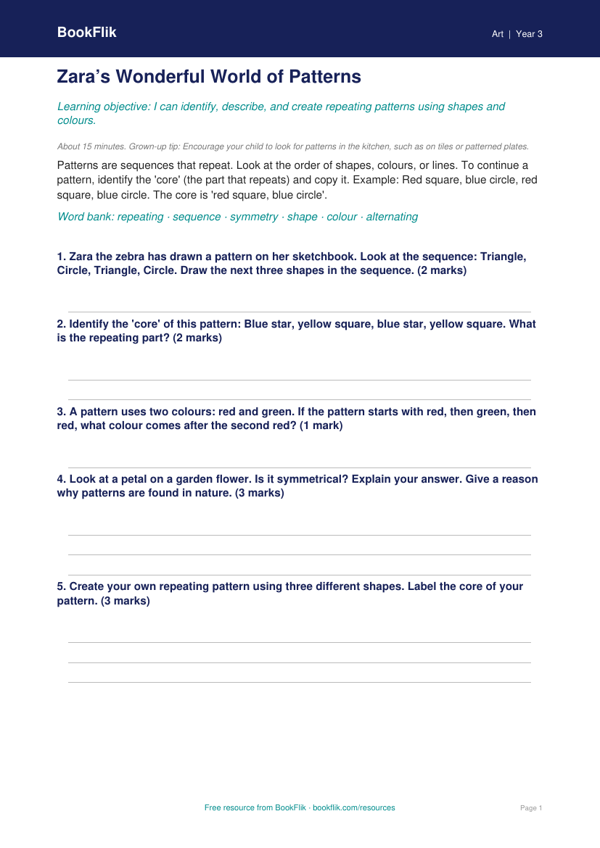
Boost your classroom creativity with our engaging Art pattern worksheet year 3 core resource. Designed specifically for Key Stage 2 learners, this activity helps children explore the beauty of repeating shapes and lines found in the natural world. By focusing on observation and design, students will develop their artistic skills while reinforcing concepts taught in the UK National Curriculum.
Our Art pattern worksheet year 3 core is perfect for teachers planning a unit on visual arts or parents looking for fun home learning activities. The resource introduces pupils to Zara the zebra, who helps children spot patterns in nature. From the stripes on a badger to the intricate veins of an oak leaf, students will learn how to identify and replicate symmetrical and asymmetrical designs. This is an essential skill for developing fine motor control and understanding spatial awareness.
This Art pattern worksheet year 3 core is fully aligned with the expectations for Year 3 pupils. It encourages children to experiment with different media, such as pencils, felt-tips, and charcoal, to create their own original patterns. The activities are structured to build confidence, starting with simple repeating sequences before moving on to more complex, multi-layered designs. It is an ideal way to encourage calm, focused creative time during the school day or as a weekend project.
Whether you are in a busy classroom in Manchester or working at the kitchen table in a quiet village, these materials are ready to print and use immediately. We have included clear instructions that are easy for seven and eight-year-olds to follow independently. For fast finishers, we have added a special creative extension challenge at the bottom of the page. Download this resource today to inspire the next generation of artists and help them see the hidden patterns in the world around them.
How to use this worksheet
- Time: about 15 minutes
- At home: Encourage your child to look for patterns in the kitchen, such as on tiles or patterned plates.
- In the classroom: Use physical objects like coloured counters to help children physically arrange their patterns before drawing them.
Preview the worksheet
If the preview does not load, open the PDF in a new tab.