
Free Sketching Template | Year 5 Greater Depth | BookFlik
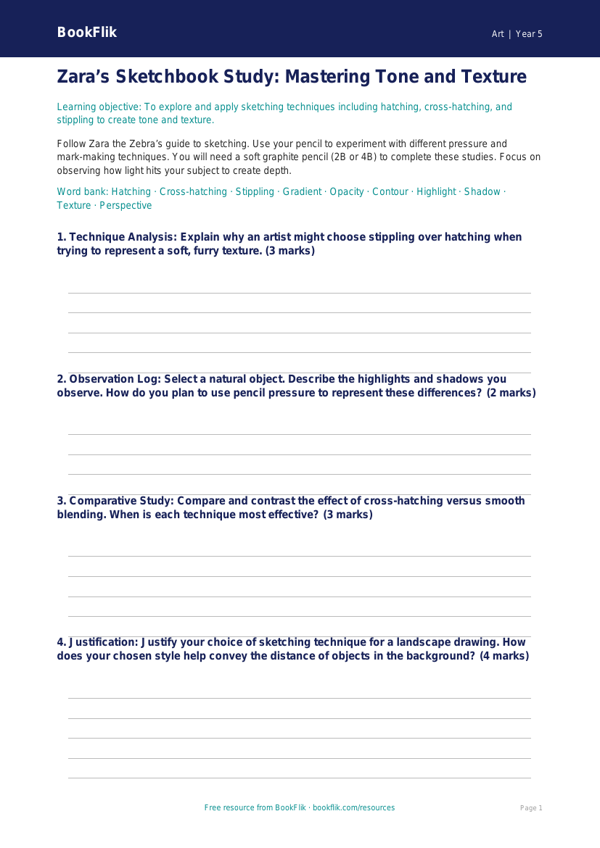
Unlock the artistic potential of your classroom with our comprehensive Art sketching template year 5 greater depth resource. Designed specifically for Key Stage 2, this pack moves beyond basic mark-making to encourage sophisticated observational drawing techniques. Pupils will explore how to manipulate light, shadow, and texture to create depth, aligning perfectly with the UK National Curriculum requirement for children to improve their mastery of art and design techniques.
This Art sketching template year 5 greater depth resource is perfect for teachers seeking to provide high-quality, structured challenges for gifted and talented learners. Instead of simple line drawings, students are prompted to experiment with cross-hatching, stippling, and tonal gradation. By using our curated prompts, pupils can analyse the structural geometry of everyday objects, effectively bridging the gap between mathematical precision and creative expression. Whether you are leading a unit on still life or natural forms, this template acts as a scaffold for advanced artistic development.
The differentiation within this pack is designed to stretch the most capable young artists. While standard tasks focus on accurate proportion, the greater depth sections require pupils to justify their choice of medium and explain how they have used composition to guide the viewer’s eye. By integrating an Art sketching template year 5 greater depth approach, you ensure that every student is pushed to refine their critical thinking skills alongside their technical ability.
What will students achieve?
1. Explain why specific shading techniques enhance the three-dimensional appearance of a sphere.
2. Compare and contrast the use of graphite pencils versus charcoal for creating intense shadows.
3. Justify your decision to use a particular viewpoint for your final sketch.
4. What might happen if you changed the light source direction?
5. Experiment with varying pressure to create a full tonal scale.
6. Create an original composition using geometric patterns.
7. Critique a peer’s work using formal artistic vocabulary.
8. Extension: Design a complex still life arrangement using found objects.
Preview the worksheet
If the preview does not load, open the PDF in a new tab.