
Free Still Life Flashcards | Year 5 Greater Depth | BookFlik
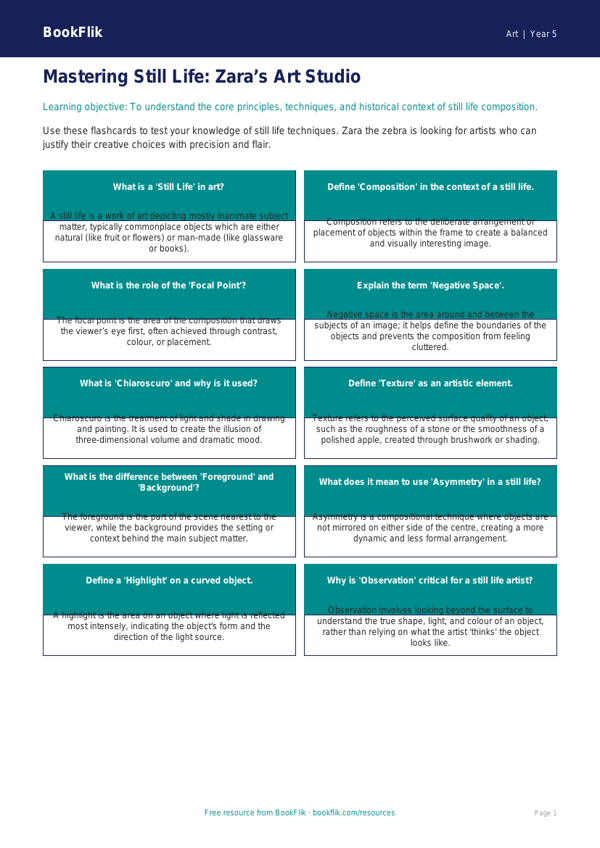
Unlock the potential of your young artists with our premium resource, Art still life flashcards year 5 greater depth. Designed specifically for the UK National Curriculum, this set moves beyond basic observational drawing to challenge pupils who are ready for a more sophisticated approach to composition, light, and tone.
Our character Zara the zebra, who is passionate about patterns and perspective, guides learners through these Art still life flashcards year 5 greater depth. While standard lessons focus on simple shapes, this set encourages children to explore complex concepts such as chiaroscuro, negative space, and the emotional impact of colour theory. Each card features high-resolution inspiration prompts, historical context about still life movements, and technical challenges designed to push artistic boundaries.
Teachers can integrate these Art still life flashcards year 5 greater depth into their weekly provision as a starter activity, a focused mastery workshop, or an independent extension task for gifted and talented learners. By analysing the interplay of light and shadow on various textures, pupils develop the critical eye required for higher-level artistic development. The resource is perfectly aligned with the Year 5 requirements for improving mastery of art and design techniques, including drawing and painting with increased proficiency.
The set includes eight rigorous questions designed to provoke higher-order thinking:
1. Explain why an artist might choose a monochromatic colour palette for a still life composition.
2. Compare and contrast the use of light in a classic Dutch still life painting versus a modern, minimalist arrangement.
3. Justify your choice of viewpoint when arranging your own still life objects.
4. What might happen to the viewer’s perception if you replaced organic objects with geometric, metallic items?
5. How does the concept of negative space alter the balance of your drawing?
6. Create a detailed plan for a still life that tells a story about a historical figure.
7. Critique your own work: how did you achieve depth through shading?
8. Propose a new arrangement of everyday objects that challenges traditional symmetry.
Preview the worksheet
If the preview does not load, open the PDF in a new tab.