
Free Databases Worksheet | Year 5 Greater Depth | BookFlik
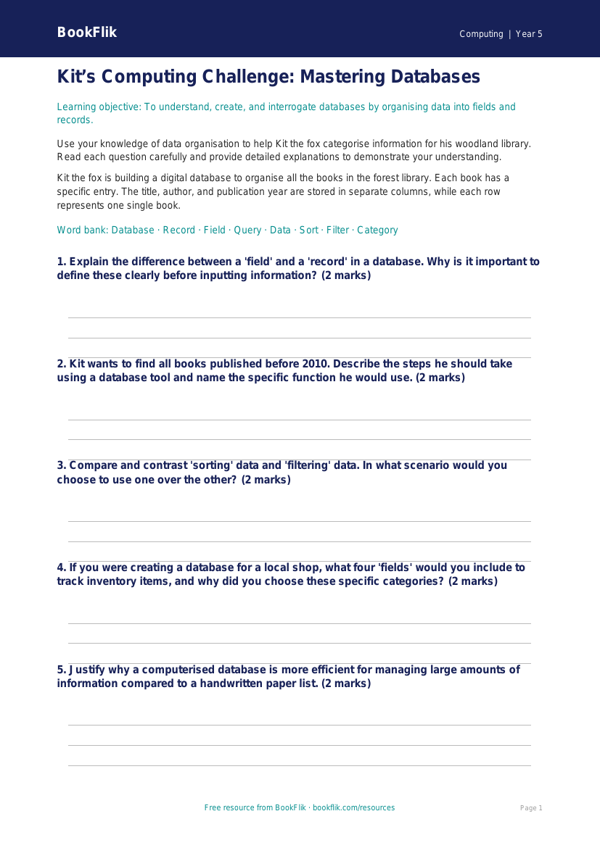
Unlock the potential of your most inquisitive learners with our premium Computing databases worksheet year 5 greater depth resource. Designed specifically for the UK National Curriculum, this activity moves beyond basic data entry, encouraging pupils to think like computer scientists as they explore the architecture of information.
In this lesson, Kit the fox guides students through the complexities of database design. Rather than simply sorting lists, children will investigate how to structure relational data, identify primary keys, and formulate complex search queries. This Computing databases worksheet year 5 greater depth is perfect for challenging those who have already mastered the fundamentals, pushing them to consider how databases power the modern world, from library catalogues to inventory systems.
Teachers can utilise this resource as a high-level extension task during a unit on data handling. It is structured to develop logical reasoning and computational thinking, helping pupils understand the relationship between fields, records, and tables. By incorporating a variety of higher-order thinking tasks, such as justifying the choice of data types and predicting the consequences of poor database design, this worksheet ensures that your gifted and talented learners remain fully engaged.
This Computing databases worksheet year 5 greater depth aligns perfectly with Year 5 computing objectives, focusing on the systematic organisation and retrieval of digital information. It includes six to eight rigorous questions designed to stretch the imagination and analytical skills of your class. Pupils will be asked to explain why specific data structures are more efficient than others and compare different methods of filtering information.
Download this free, professionally crafted resource to provide your students with the intellectual stimulation they deserve. It is an essential tool for any classroom teacher aiming to foster a deep, conceptual understanding of how we store, manage, and manipulate the vast amounts of data that surround us in our daily lives.
Preview the worksheet
If the preview does not load, open the PDF in a new tab.