
Free Databases Writing Frame | Year 5 Greater Depth | BookFlik
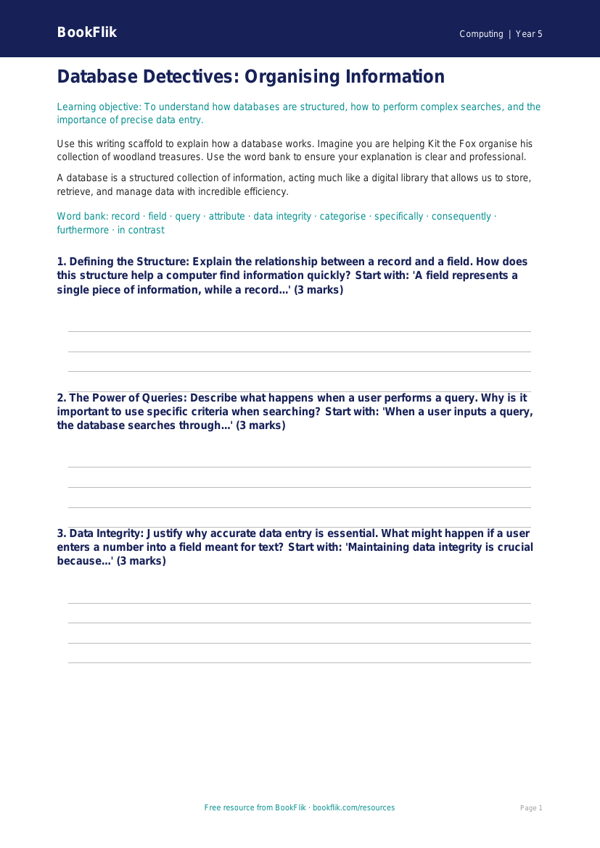
Mastering the fundamentals of data organisation is a key requirement of the UK National Curriculum for Computing. This free Computing databases writing frame year 5 greater depth resource is meticulously designed to help high-achieving pupils move beyond simple data entry and into the world of complex relational thinking. By using this structured guide, students will explore how databases store, query, and retrieve information effectively.
The resource features Kit, our clever fox, who guides pupils through the logical steps of designing a database schema. Children will learn to define fields, identify primary keys, and formulate precise search queries to extract specific datasets. This Computing databases writing frame year 5 greater depth is perfect for teachers looking to stretch their most capable learners during ICT or computing lessons. Whether you are teaching pupils how to filter data or how to construct multi-criteria searches, this frame provides the scaffolding necessary for pupils to articulate their computational thinking processes clearly.
Aligned with Year 5 objectives, this writing frame encourages students to justify their choice of data types and evaluate the efficiency of different search strategies. It is an ideal tool for classroom use, homework tasks, or as part of a deeper investigation into how digital systems manage information. By incorporating this Computing databases writing frame year 5 greater depth, educators can ensure that gifted pupils are challenged to explain the ‘why’ behind their database structure rather than just the ‘how’.
The resource includes a range of higher-order tasks, such as:
1. Explain why choosing an appropriate data type for a field is essential for database accuracy.
2. Compare and contrast a flat-file database with a relational database.
3. Justify your decision to use a specific filter when searching for items within a large dataset.
4. What might happen if a database field contained inconsistent data formats?
5. Design a database schema for a library system, including primary keys.
6. Create an original scenario where a database would be the most efficient tool to solve a problem.
Preview the worksheet
If the preview does not load, open the PDF in a new tab.