
Free Debugging Flashcards | Year 3 Core | BookFlik
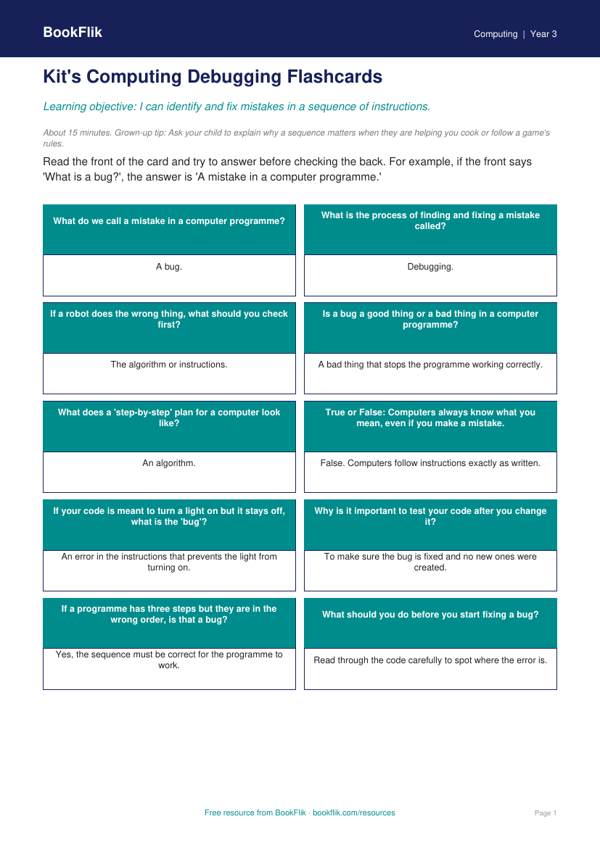
Boost your primary classroom or home learning sessions with our free Computing debugging flashcards year 3 core resource. Designed specifically for the UK National Curriculum, these flashcards help children aged 7-8 master the essential skill of identifying and correcting errors in their code.
Debugging is a vital part of the Year 3 computing programme. When children learn to spot a bug in a sequence of instructions, they develop logical thinking and resilience. Our Computing debugging flashcards year 3 core set introduces pupils to common mistakes, such as incorrect sequences or missing steps in an algorithm. By using these cards, children learn to look at a set of instructions—like those for making a jam sandwich or guiding a robot across a grid—and spot exactly where the process goes wrong.
Teachers and parents can use these cards during quiet morning work, as a fast-paced plenary activity, or as part of a small group intervention. Each card features a simple scenario with a clear bug for the child to solve. Because this set focuses on the Computing debugging flashcards year 3 core expectations, the language is accessible and the logic puzzles match the level of difficulty expected at this stage of Key Stage 2.
We have included a mix of recall questions and practical application tasks. Pupils will practice vocabulary like algorithm, sequence, and bug, ensuring they feel confident before they move on to more complex programming tasks. The resource is fully aligned with UK standards, using familiar contexts such as playground games or school routines to make abstract computing concepts feel relatable and fun. Whether you are in a busy classroom in Manchester or supporting learning at home in a quiet village, these flashcards provide a practical, hands-on way to build digital literacy skills. Download your set today and help your learners become expert code-fixers!
How to use this flashcards
- Time: about 15 minutes
- At home: Ask your child to explain why a sequence matters when they are helping you cook or follow a game’s rules.
- In the classroom: Use these cards in pairs; one child reads the question while the other explains the reasoning behind the answer.
Preview the worksheet
If the preview does not load, open the PDF in a new tab.