
Free Programming Assessment | Year 3 Core | BookFlik
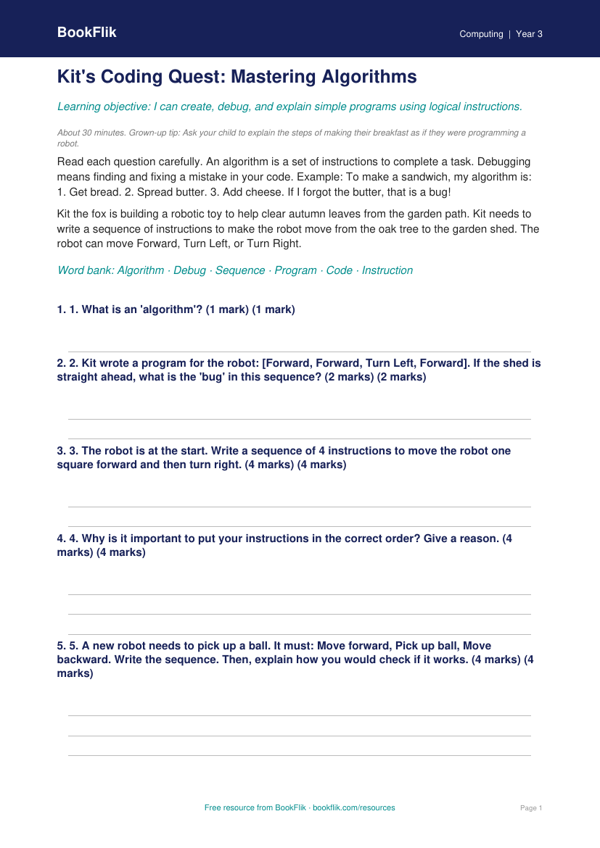
Boost your pupils’ confidence with our free Computing programming assessment year 3 core resource. Designed specifically for the UK National Curriculum, this activity helps children master the fundamentals of coding in a fun, engaging way.
In this assessment, children join Kit the fox on a digital adventure through a virtual woodland. They will learn how to design simple algorithms, predict the behaviour of a sequence of commands, and debug basic errors in a programme. By focusing on logical reasoning, students develop the skills needed to solve complex puzzles. This Computing programming assessment year 3 core ensures that learners understand how to use sequence, selection, and repetition in their coding projects.
Teachers can use this resource as a summative tool at the end of a unit or as a quick check-up during a lesson. Parents will find it an excellent way to support learning at home, helping children gain familiarity with computational thinking. Because this is a Computing programming assessment year 3 core, it is perfectly pitched at the expected standard for lower Key Stage 2. It avoids overly complex syntax, focusing instead on the core concepts of programming logic that form the foundation of the national curriculum.
We have included clear instructions and helpful tips from Kit the fox to make the task accessible for all students. Whether used in the classroom or as a quiet homework activity, this resource builds essential digital literacy skills. The assessment covers key areas such as identifying bugs, planning a sequence of steps, and understanding how computers follow instructions. By using this Computing programming assessment year 3 core, you provide your children with the tools they need to succeed in their digital journey. Download this pack today to help your Year 3 class become confident, creative programmers who enjoy solving challenges with logic and precision.
How to use this assessment
- Time: about 30 minutes
- At home: Ask your child to explain the steps of making their breakfast as if they were programming a robot.
- In the classroom: Use physical ‘robot’ games in the playground to help children understand that instructions must be precise.
Preview the worksheet
If the preview does not load, open the PDF in a new tab.