
Free Programming Writing Frame | Year 5 Greater Depth | BookFlik
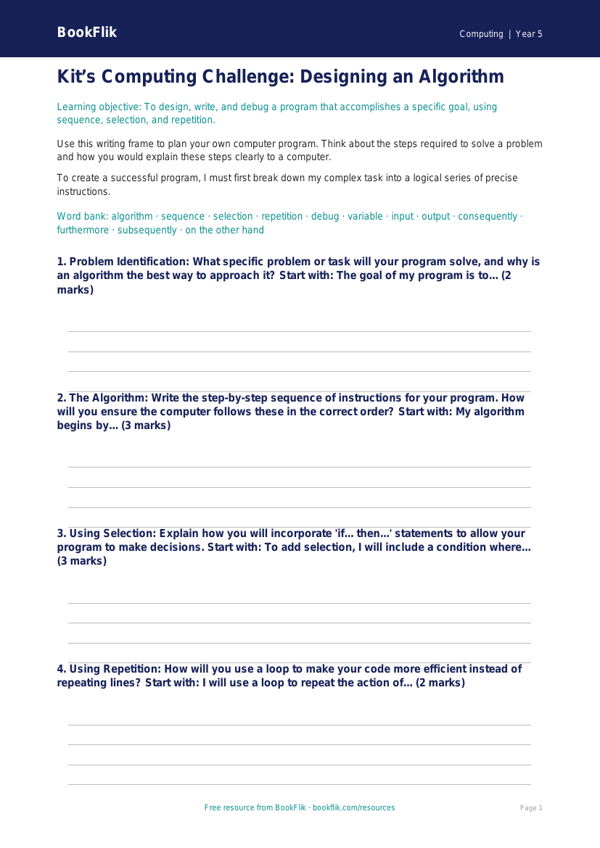
Boost your pupils’ computational thinking with our bespoke Computing programming writing frame year 5 greater depth resource. Designed specifically for the UK National Curriculum, this scaffolded tool helps students articulate complex algorithmic logic, debugging processes, and variable manipulation with precision and clarity.
As pupils progress through their study of sequence, selection, and repetition, they often struggle to bridge the gap between practical coding and written explanation. This Computing programming writing frame year 5 greater depth resource bridges that divide by providing sophisticated sentence starters and technical vocabulary banks. It encourages learners to move beyond simple descriptions and begin justifying their choice of control structures. Whether your class is designing a complex game or automating a sequence, this frame ensures they can document their computational journey using formal, precise language.
This resource is perfectly aligned with the Year 5 Computing curriculum, focusing on designing, writing, and debugging programs that accomplish specific goals. By using this Computing programming writing frame year 5 greater depth, teachers can support high-attaining pupils to reflect on efficiency and logical flow. The frame includes higher-order thinking prompts that challenge students to predict outcomes and propose alternative solutions.
How to use this resource:
Distribute the frame during the ‘evaluate’ phase of your programming unit. It is ideal for independent work or as a catalyst for paired discussions where pupils must explain their code to a peer. The included extension tasks push gifted learners to consider the impact of variables and the importance of user-friendly interfaces.
Challenge your most able students with these deeper learning questions:
1. Explain why a specific loop structure is more efficient than repeating lines of code.
2. Compare and contrast the use of selection in two different algorithms.
3. Justify your choice of variable names for clarity and readability.
4. What might happen if an input value falls outside your intended range?
5. Critique a peer’s algorithm: suggest one improvement for performance.
6. Design a new feature for your program and explain the logic required to implement it.
Preview the worksheet
If the preview does not load, open the PDF in a new tab.