
Free Adverbs Word Mat | Year 6 Core | BookFlik
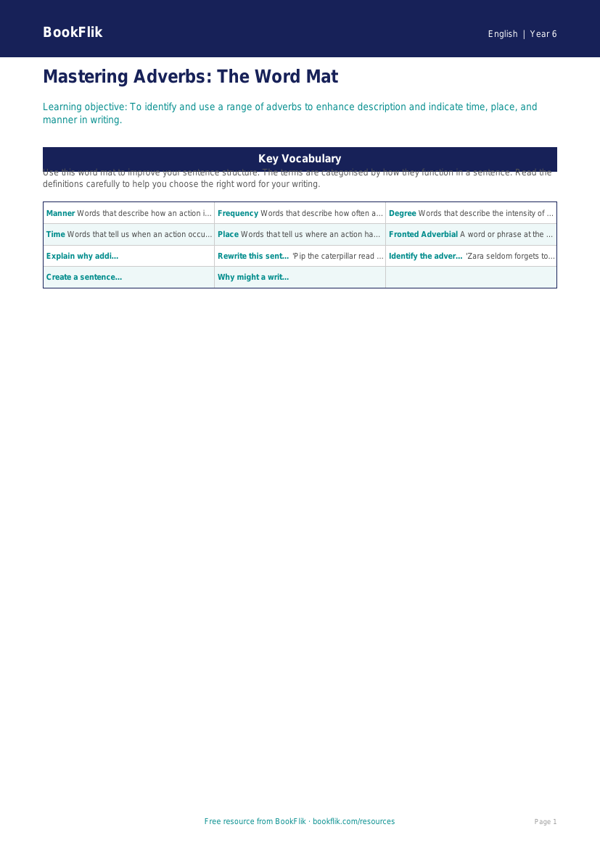
Boost your pupils’ writing precision with our comprehensive resource, the English adverbs word mat year 6 core. Designed specifically for the UK National Curriculum, this essential classroom tool helps Year 6 students elevate their descriptive writing by moving beyond basic vocabulary.
At this stage of their education, children are expected to use adverbs to indicate degrees of possibility, show frequency, and enhance the clarity of their sentences. Our English adverbs word mat year 6 core provides a curated selection of sophisticated adverbs, categorised by their function. Whether pupils are writing narrative stories, persuasive arguments, or formal reports, this mat ensures they have the right vocabulary at their fingertips to add nuance and flow to their work.
Teachers can use this resource in several ways. It is perfect as a permanent fixture on desks for independent writing tasks, a helpful prompt during guided writing sessions, or a quick reference guide during peer-assessment activities. By using the English adverbs word mat year 6 core, children become more confident in selecting powerful vocabulary to modify verbs, adjectives, and other adverbs, effectively meeting the higher expectations of the Key Stage 2 curriculum.
This resource is tailored to the expected standard for Year 6, ensuring that the vocabulary included is challenging yet accessible. It encourages students to experiment with sentence structure, helping them to move away from repetitive phrasing and towards more sophisticated, varied prose. Alongside the mat, we have included five practice questions to test their understanding:
1. Identify the adverb of frequency in this sentence: “He rarely forgets his homework.”
2. Rewrite this sentence adding an adverb of possibility: “The train will arrive on time.”
3. Which adverb could replace ‘quickly’ to make the sentence more descriptive?
4. Use an adverb to show the degree of an action.
5. Explain how an adverb changes the meaning of the verb ‘ran’.
Download this free, high-quality resource today to support your class in mastering the art of descriptive English.
Preview the worksheet
If the preview does not load, open the PDF in a new tab.