
Free Diary Writing Word Mat | Year 3 Core | BookFlik
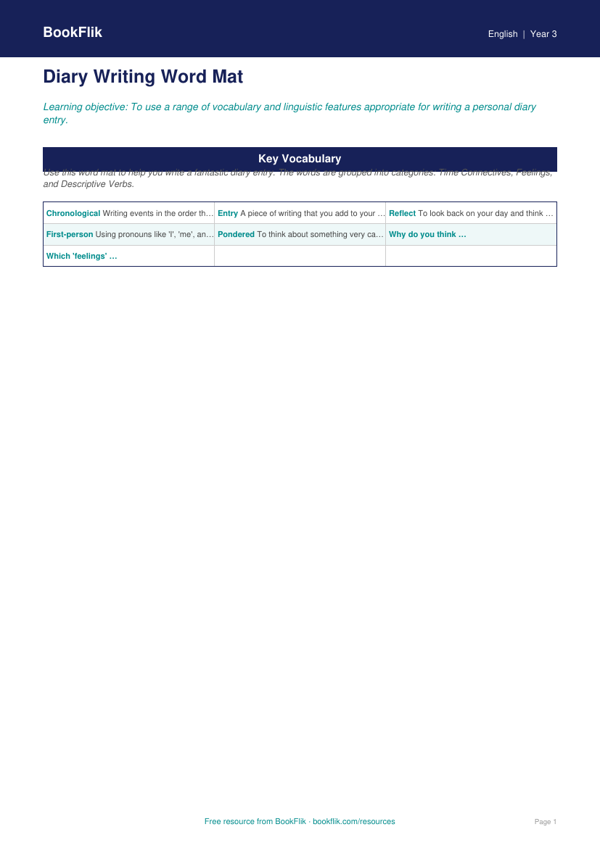
Help your pupils master the art of personal storytelling with our free English diary writing word mat year 3 core resource. Designed specifically to support children aged 7-8, this high-quality printable is the perfect companion for any literacy lesson focused on recount writing.
What will children learn?
This resource encourages pupils to move beyond simple sentence structures by providing a curated selection of time conjunctions, emotional adjectives, and sensory verbs. By using this English diary writing word mat year 3 core, students will learn how to sequence events chronologically, use the first-person perspective effectively, and add descriptive detail to their writing. It helps them explore the difference between formal reports and personal reflections, ensuring their writing sounds authentic and engaging.
How teachers can use it
Teachers can print this resource for independent writing stations or keep it in literacy folders for quick reference. It is an excellent tool for scaffolding the drafting process, allowing children to focus on their creative ideas while having essential vocabulary at their fingertips. Whether you are teaching a unit on historical figures or a creative project about a fictional adventure, this mat provides the perfect building blocks.
Curriculum alignment and differentiation
Aligned with the UK National Curriculum for Year 3, this resource focuses on the requirements for composition, including the use of conjunctions and adverbs to express time and cause. This specific version is pitched at the core level, providing the expected standard of vocabulary and grammatical support for pupils working at age-related expectations.
We have included five questions at the end of the mat to test comprehension and application:
1. Which time conjunctions can you use to start a new paragraph?
2. Can you find three adjectives to describe a feeling of excitement?
3. Rewrite one sentence from your diary using a fronted adverbial from the mat.
4. Why is it important to use the first-person pronoun in a diary?
5. How can you use sensory verbs to describe a setting?
Download this English diary writing word mat year 3 core today and watch your pupils’ confidence grow!
Preview the worksheet
If the preview does not load, open the PDF in a new tab.