
Free Figurative Language Flashcards | Year 5 Greater Depth | BookFlik
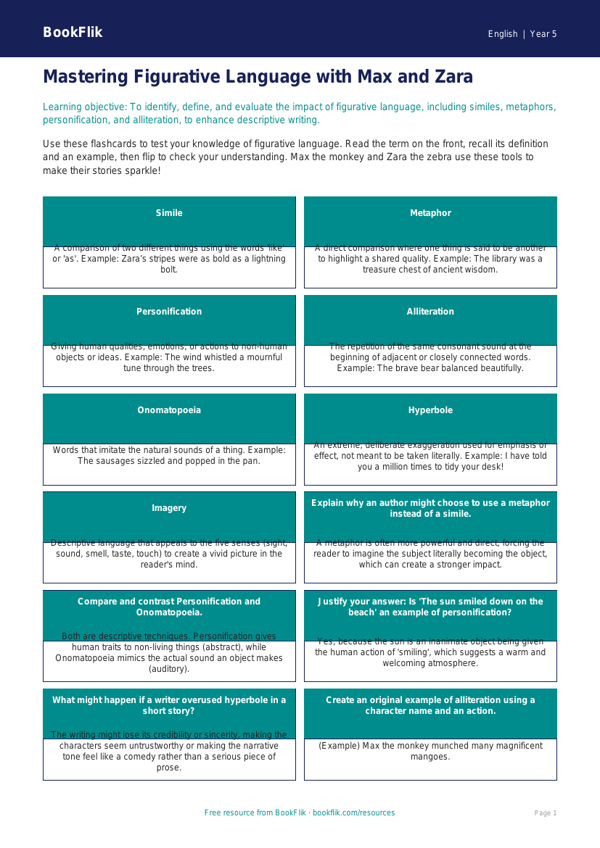
Boost your classroom resources with our premium set of English figurative language flashcards year 5 greater depth. Designed specifically for ambitious learners, these materials go beyond basic definitions to encourage sophisticated analysis and creative application of linguistic devices.
In this pack, pupils explore advanced figurative concepts including extended metaphors, personification, hyperbole, and onomatopoeia. By engaging with these English figurative language flashcards year 5 greater depth, children will learn to identify how authors manipulate language to create atmosphere, tone, and character depth. Each card features a challenging literary excerpt followed by a prompt requiring a nuanced explanation of the author’s intent.
These resources are perfectly aligned with the UK National Curriculum, specifically supporting the Year 5 requirement for pupils to understand and discuss how authors use figurative language to create effect. Teachers can utilise these as a starter activity for guided reading sessions, as a challenge task for fast finishers, or as a collaborative game to spark rich classroom discussion.
What sets these apart is the focus on higher-order thinking. We have specifically curated these English figurative language flashcards year 5 greater depth for gifted and talented students who are ready to move from simple identification to critical synthesis. The set includes 8 distinct tasks that push pupils to justify their interpretations and experiment with their own descriptive writing.
Example tasks include:
1. Explain why an author might choose a specific metaphor over a simile to convey a character’s internal struggle.
2. Compare and contrast the effectiveness of personification in two different poetic stanzas.
3. Justify your answer: Does the use of hyperbole in this passage enhance the humour or distract from the narrative?
4. What might happen if you replaced the imagery in this text with literal descriptions? How would the reader’s engagement change?
5. Create an original piece of descriptive prose using at least three distinct types of figurative language.
6. Analyse the rhythm and impact of onomatopoeia in an action sequence.
Preview the worksheet
If the preview does not load, open the PDF in a new tab.