
Free Inference Word Mat | Year 5 Greater Depth | BookFlik
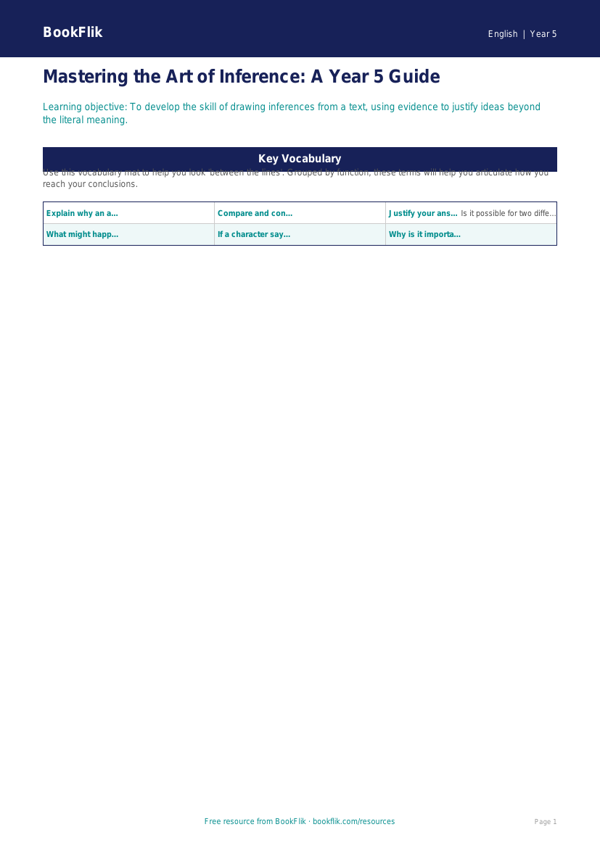
Unlock the secrets of reading between the lines with our premium English inference word mat year 5 greater depth resource. Designed specifically for ambitious learners, this comprehensive tool moves beyond basic comprehension to help pupils decode subtext, character motivations, and subtle authorial intent.
What children will learn:
This resource provides a sophisticated vocabulary bank featuring nuanced verbs and adjectives that describe hidden meanings. Pupils will move from simple deduction to complex interpretation, learning how to identify clues in a text that point towards a character’s internal emotional state or the atmospheric tone of a narrative. It is the perfect companion for students ready to tackle challenging literature and nuanced poetry.
How teachers can use it:
Teachers can incorporate this English inference word mat year 5 greater depth into guided reading sessions or independent writing tasks. It serves as an essential scaffold for pupils who need to articulate their analytical thoughts using precise terminology. By using the provided sentence starters and analytical stems, students can structure their justifications effectively during class discussions.
Curriculum alignment and differentiation:
Aligned with the UK National Curriculum for Year 5, this resource focuses on the statutory requirement for pupils to draw inferences such as inferring characters’ feelings, thoughts, and motives from their actions. This specific version is tailored for greater depth learners, offering higher-order thinking prompts that encourage children to justify their answers with textual evidence.
Why choose this resource?
Our English inference word mat year 5 greater depth includes 8 rigorous challenges, such as:
1. Explain why the author chose a specific verb to describe a character’s reaction.
2. Justify your answer by citing two distinct pieces of evidence from the text.
3. Compare and contrast the underlying motives of two different protagonists.
4. What might happen if the setting were changed, and how would that alter the inference?
5. Predict the character’s next move based on their established behavioural patterns.
6. Analyse the impact of the author’s word choice on the reader’s perception.
7. Create an alternative ending based on a hidden clue.
8. Critique the reliability of the narrator.
Preview the worksheet
If the preview does not load, open the PDF in a new tab.