
Free Punctuation Worksheet for EYFS | Core Skills | BookFlik
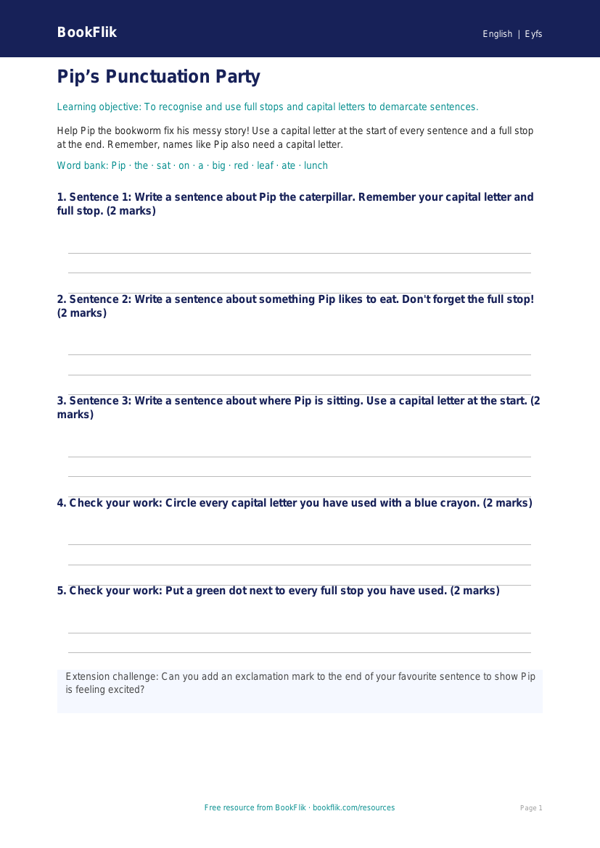
Boost your early years classroom with our engaging English punctuation template eyfs core resource. Designed specifically for children aged 3 to 5, this printable set helps pupils develop a foundational understanding of sentence structure and the importance of marks in writing. Whether your students are just beginning to recognise full stops or are starting to use them independently in their own creative stories, this English punctuation template eyfs core provides the perfect visual aid to support their progress.
What will children learn?
Pupils will explore the function of full stops, exclamation marks, and question marks. Through interactive activities, they will learn that a full stop signals the end of a thought, helping them to organise their ideas clearly. By using this English punctuation template eyfs core, children will practise placing these marks correctly, which supports their development in literacy and communication as outlined in the Early Years Foundation Stage (EYFS) Statutory Framework.
How teachers can use it
This resource is highly versatile. Teachers can use it during whole-class phonics sessions, small group focus tasks, or as part of a continuous provision literacy station. It is perfectly aligned with the UK National Curriculum goal of encouraging children to write sentences that can be read by themselves and others. The activities are designed to be hands-on, allowing children to physically place punctuation markers onto sentences, making abstract concepts concrete and fun.
Differentiation
This resource is tailored for learners working at the expected standard. It encourages children to apply their knowledge of phonics and sentence structure to real-world writing tasks.
Check for understanding with these questions:
1. What does a full stop tell us to do when we are reading?
2. Can you find the end of this sentence and place a full stop?
3. Which mark do we use when we are excited?
4. If I ask a question, which mark should I use?
5. Why do we need punctuation in our writing?
Preview the worksheet
If the preview does not load, open the PDF in a new tab.