
Free Sentence Structure Word Mat | Year 6 Core | BookFlik
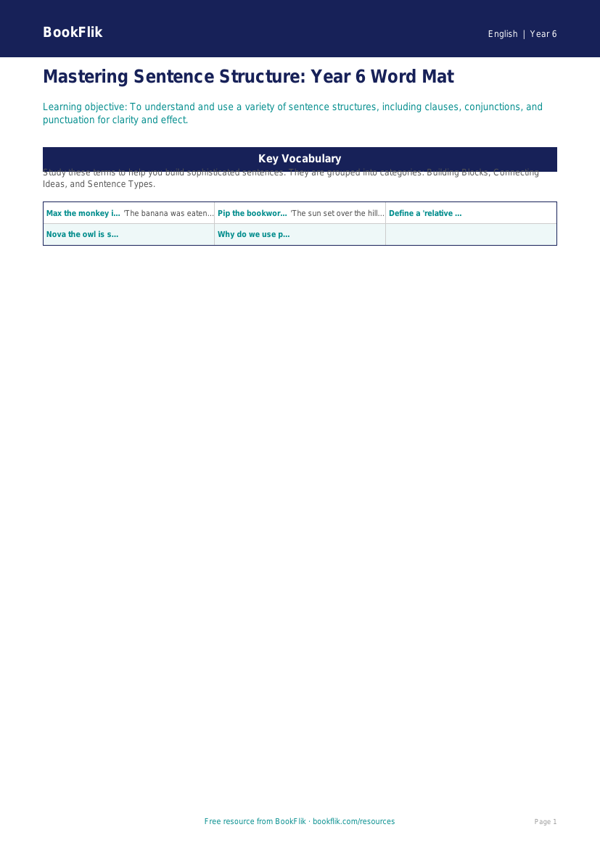
Boost your classroom writing standards with our comprehensive English sentence structure word mat year 6 core resource. Designed specifically for pupils working at the expected standard, this printable aid is an essential tool for helping children master the complexities of advanced grammar and syntax required by the UK National Curriculum.
This resource helps students confidently vary their writing by providing clear examples and definitions of key sentence types. Inside, children will find helpful guides on using relative clauses, fronted adverbials, and passive voice. By using this English sentence structure word mat year 6 core, learners can easily refer to examples of how to connect independent clauses using semicolons, colons, and dashes to add sophistication to their creative and non-fiction writing.
Teachers can use this mat during independent writing tasks, as a quick reference guide during English lessons, or as a helpful scaffold for pupils who need a gentle reminder of how to structure complex sentences. It is perfectly aligned with the Year 6 English curriculum expectations, ensuring that students are well-prepared for their end-of-key-stage assessments.
The design is clean, accessible, and clutter-free, making it ideal for the primary classroom. Whether your students are drafting a persuasive letter or writing a narrative story, this English sentence structure word mat year 6 core acts as a steady companion to improve sentence flow and grammatical accuracy.
Included with the mat are five challenge questions to test their knowledge:
1. Can you identify the relative clause in this sentence?
2. Rewrite a simple sentence by adding a fronted adverbial.
3. Use a semicolon to join two independent clauses.
4. Convert an active sentence into the passive voice.
5. Explain why a comma is used after a fronted adverbial.
Download this free resource today to help your Year 6 class reach their full writing potential with confidence and clarity.
Preview the worksheet
If the preview does not load, open the PDF in a new tab.