
Free Stories Word Mat | Year 5 Core | BookFlik
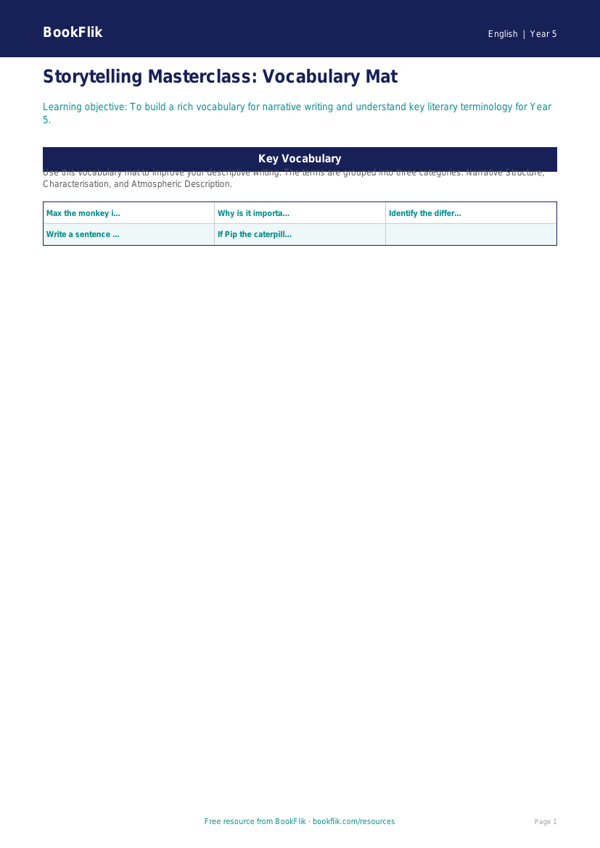
Boost your classroom literacy resources with our comprehensive English stories word mat year 5 core. Designed specifically for the UK National Curriculum, this essential tool helps students elevate their creative writing by providing a rich bank of vocabulary to describe characters, settings, and plot development.
In Year 5, children are expected to craft increasingly complex narratives using varied sentence structures and ambitious language. Our English stories word mat year 5 core supports this by offering precise synonyms for common verbs and adjectives, helping pupils move away from basic descriptions towards more evocative storytelling. Whether students are writing suspenseful mysteries or historical adventures, this resource ensures they have the right words at their fingertips to engage their readers.
Teachers can use this resource as a permanent fixture on desks during independent writing tasks, or as a scaffold for guided writing sessions. It is particularly effective for encouraging pupils to experiment with “show, don’t tell” techniques, allowing them to describe a character’s emotions or a setting’s atmosphere with greater depth. Because this English stories word mat year 5 core is designed for learners working at the expected standard, it bridges the gap between simple sentence construction and more sophisticated, flowing prose.
The mat includes sections on powerful openers, transition words for chronological order, and sensory language to bring scenes to life. By keeping this resource accessible, you empower your pupils to take ownership of their writing journey, fostering confidence and reducing the barrier of finding the perfect word.
To support your lesson planning, we have included five challenge questions to test your pupils’ understanding:
1. Can you find three adjectives on the mat to describe a stormy setting?
2. Which conjunctions can you use to join two simple sentences together?
3. Rewrite a boring sentence using one of the “powerful verbs” listed.
4. How do these words help you show, rather than tell, that a character is nervous?
5. Select a transition word to start a new paragraph in your story.
Preview the worksheet
If the preview does not load, open the PDF in a new tab.