
Free Vocabulary Track Sheet | Year 5 Greater Depth | BookFlik
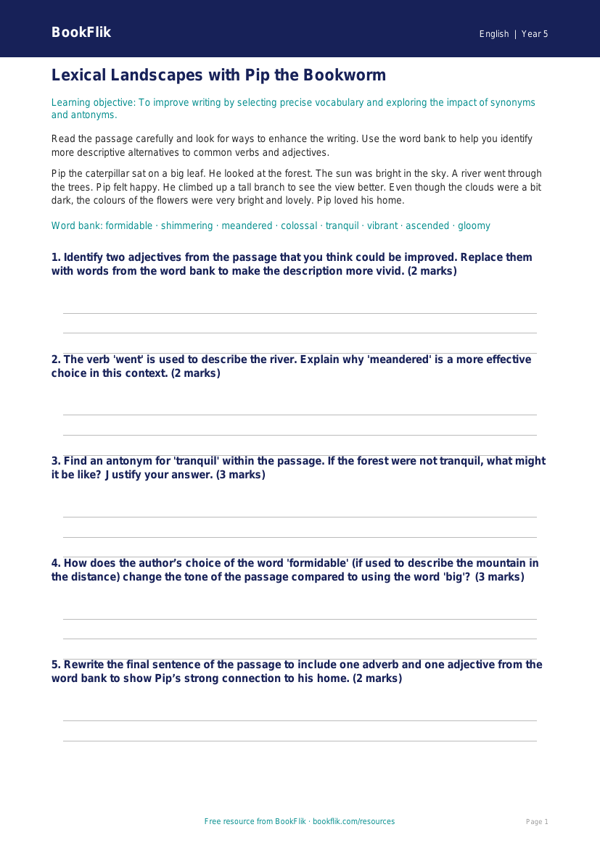
Elevate your classroom literacy standards with our premium English vocabulary track sheet year 5 greater depth resource. Designed specifically for ambitious learners, this tool is an essential asset for educators aiming to stretch pupils beyond the standard curriculum expectations. Our original character, Pip the bookworm caterpillar, guides students through a journey of linguistic discovery, encouraging them to move past basic adjectives and verbs toward more sophisticated, precise alternatives.
This comprehensive English vocabulary track sheet year 5 greater depth is meticulously aligned with the UK National Curriculum, focusing on the statutory requirements for Year 5 spelling and vocabulary development. By utilising this tracker, students will learn to categorise synonyms and antonyms, explore etymology, and experiment with nuanced word choices to improve the impact of their creative writing. Teachers can seamlessly integrate this resource into daily lessons, using it as a diagnostic tool for formative assessment or as a personalised log for pupils to curate their own ‘word banks’.
The resource is explicitly differentiated for greater depth, providing high-achieving learners with opportunities to engage in complex linguistic analysis. It includes higher-order thinking tasks that challenge pupils to justify their word choices and evaluate the effect of vocabulary on a reader’s response. By incorporating this English vocabulary track sheet year 5 greater depth into your planning, you provide a structured pathway for children to master the vocabulary-rich environment required for success in upper Key Stage 2.
The pack includes six rigorous challenge questions, including:
1. Explain why a writer might choose the word ‘formidable’ instead of ‘scary’ in a descriptive passage.
2. Compare and contrast the impact of emotive language in two different genres.
3. Justify your use of specific adverbs to modify tone.
4. What might happen if you replaced all the adjectives in your narrative with more precise alternatives?
5. Categorise these archaic words by their origin.
6. Create an original poem using at least five ‘Tier 3’ vocabulary words.
Preview the worksheet
If the preview does not load, open the PDF in a new tab.