
Free Population Writing Frame | Year 5 Greater Depth | BookFlik
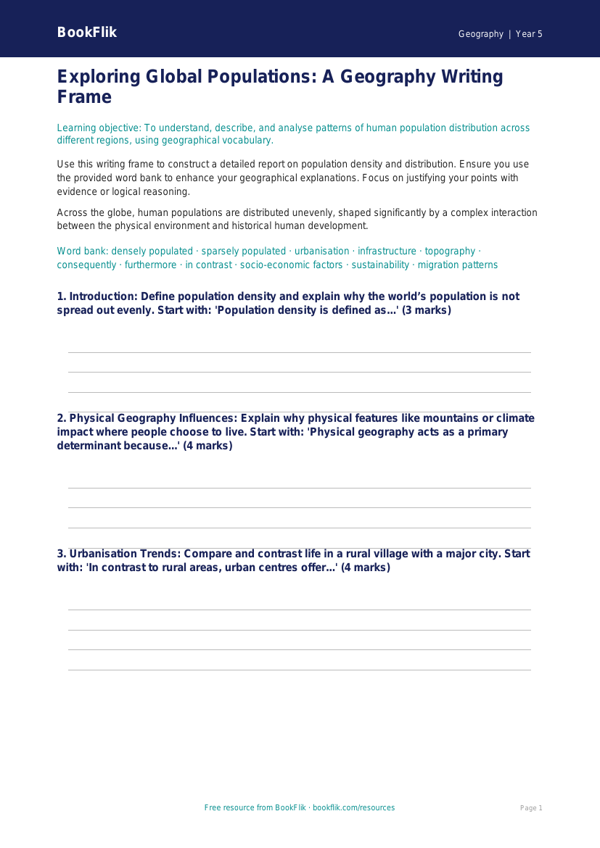
Unlock the complexities of human geography with our premium Geography population writing frame year 5 greater depth resource. Designed specifically for Key Stage 2, this scaffolded tool helps pupils move beyond simple descriptions to provide nuanced, analytical insights into global settlement patterns.
By using this Geography population writing frame year 5 greater depth, children will explore essential geographical concepts such as urbanisation, rural-to-urban migration, and the factors influencing population density. The framework encourages students to investigate why populations cluster in specific regions, such as near rivers or industrial hubs, whilst considering the environmental and social impacts of rapid growth. This resource aligns perfectly with the UK National Curriculum, which requires Year 5 pupils to understand human geography, including types of settlement and land use.
Teachers can utilise this template as a core lesson activity or as a high-challenge extension task. The structure is purposefully designed to push gifted and talented learners, prompting them to move past basic observation. Instead of merely listing facts, pupils are guided to justify their reasoning and synthesise evidence. This Geography population writing frame year 5 greater depth includes six to eight rigorous questions that demand higher-order thinking, such as: Explain why a city might experience rapid expansion; compare and contrast the needs of a remote village versus a bustling metropolis; and justify your answer regarding the potential future challenges of overpopulation.
Our original characters, Finn the dolphin and Ellie the elephant, feature throughout the resource to provide context for geographical exploration. With its focus on sophisticated vocabulary and critical analysis, this writing frame ensures that students develop the academic rigour required for success in upper Key Stage 2. Download this free tool today to inspire your pupils to think like geographers, analyse complex data, and articulate their findings with clarity, precision, and depth.
Preview the worksheet
If the preview does not load, open the PDF in a new tab.