
Free Volcanoes Word Mat | Year 5 Greater Depth | BookFlik
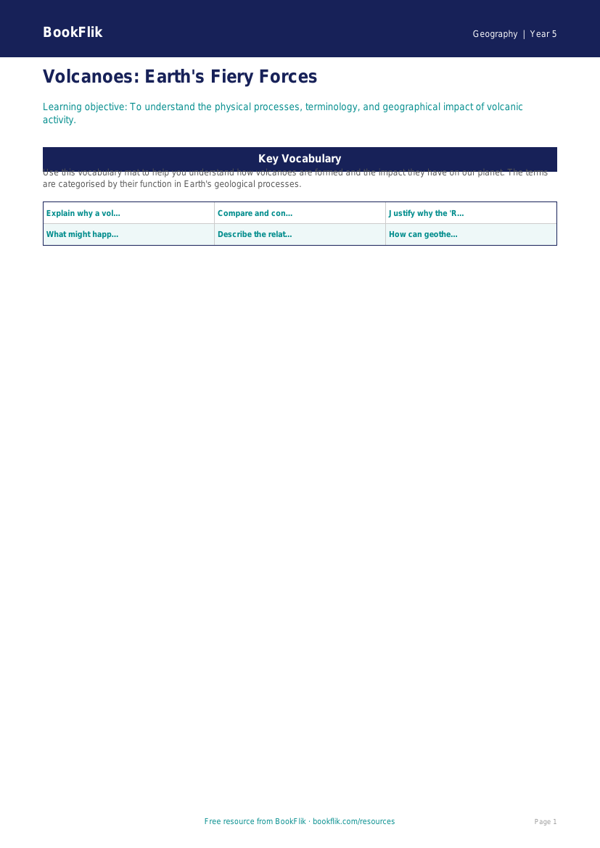
Enhance your classroom resources with our expertly crafted Geography volcanoes word mat year 5 greater depth. Designed specifically for pupils exceeding age-related expectations, this comprehensive resource moves beyond basic definitions to encourage the use of sophisticated geographical terminology. This Geography volcanoes word mat year 5 greater depth provides a scaffold for students to articulate complex processes, such as tectonic plate movement, the distinction between magma and lava, and the classification of volcanic eruptions.
Aligned with the UK National Curriculum for upper Key Stage 2, this mat supports students in mastering the vocabulary required to describe physical geographical processes. It is an essential tool for teachers looking to elevate written explanations and classroom discussions. By providing terms such as pyroclastic flow, vent, crater, and dormant, the resource ensures that learners can communicate their scientific understanding with precision and clarity.
The differentiation within this Geography volcanoes word mat year 5 greater depth is tailored for gifted and talented learners. It challenges them to move past simple descriptions and engage in higher-order thinking. To facilitate this, we have included eight extension questions designed to stretch their analytical skills:
1. Explain why volcanoes are frequently located along the boundaries of tectonic plates.
2. Compare and contrast the characteristics of shield volcanoes and composite volcanoes.
3. Justify your answer: Why do some populations choose to live near active volcanic regions despite the inherent risks?
4. What might happen if a super-volcano erupted in a densely populated area?
5. Describe the impact of volcanic ash on the local atmosphere and climate.
6. Analyse the differences between effusive and explosive eruptions.
7. Create a diagram illustrating the movement of convection currents in the mantle.
8. Propose a plan for an early warning system in a volcanic zone.
Download this resource today to support your pupils in developing a deep, nuanced understanding of our dynamic planet.
Preview the worksheet
If the preview does not load, open the PDF in a new tab.