
Free Black History Month Poster | Year 6 Greater Depth | BookFlik
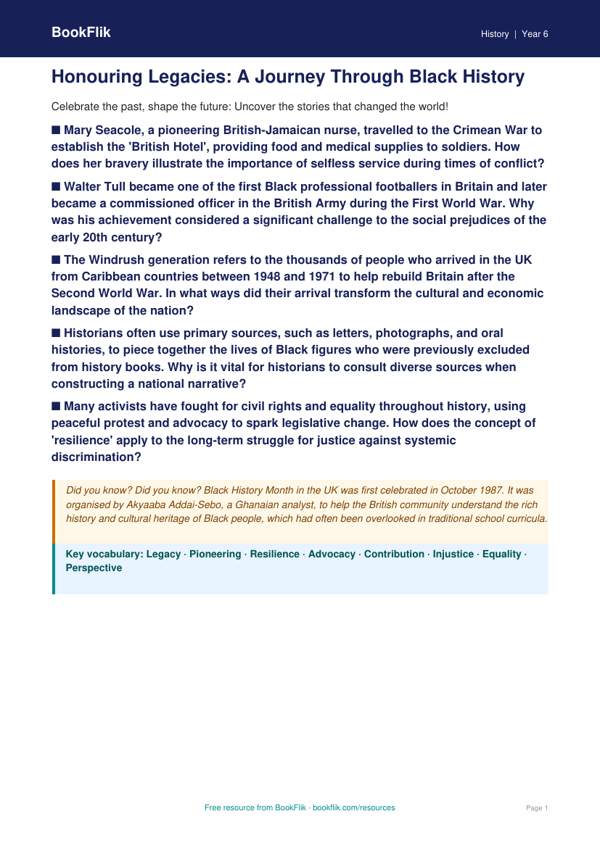
Celebrate the rich tapestry of British history with our latest educational resource. This History black history month poster year 6 greater depth pack provides an immersive, visually engaging way to explore significant figures and pivotal moments that have shaped our nation. Designed specifically for Year 6 pupils, this resource moves beyond simple timelines to encourage critical analysis and historical enquiry.
Our History black history month poster year 6 greater depth resource is meticulously aligned with the UK National Curriculum, supporting the study of significant individuals and thematic units that bridge the gap between local and global history. Pupils will delve into the contributions of key figures such as Mary Seacole and Walter Tull, while exploring the complexities of the British Empire and the long-standing presence of Black communities in Britain.
Teachers can utilise this poster as a striking classroom centrepiece or as an anchor for a series of investigative lessons. The accompanying teacher notes include differentiated questions designed to stretch high-achieving learners. These tasks require students to evaluate historical interpretations, analyse primary source evidence, and consider the impact of systemic change over time. By incorporating this History black history month poster year 6 greater depth toolkit, educators can facilitate meaningful classroom discussions that challenge pupils to justify their historical arguments and compare diverse perspectives with nuance and empathy.
The resource includes a range of higher-order thinking tasks, such as:
1. Explain why the contributions of specific individuals were often overlooked in historical records for decades.
2. Compare and contrast the experiences of Black Britons in different centuries.
3. Justify your answer: How does understanding these personal narratives change our perspective of British national identity?
4. What might happen if we only relied on one source of evidence when studying historical events?
5. Create an original research proposal on a figure of your choice.
6. Synthesise your findings into a persuasive essay on the importance of inclusive historiography.
Preview the worksheet
If the preview does not load, open the PDF in a new tab.