
Free Cube Numbers Worksheet | Year 5 Greater Depth | BookFlik
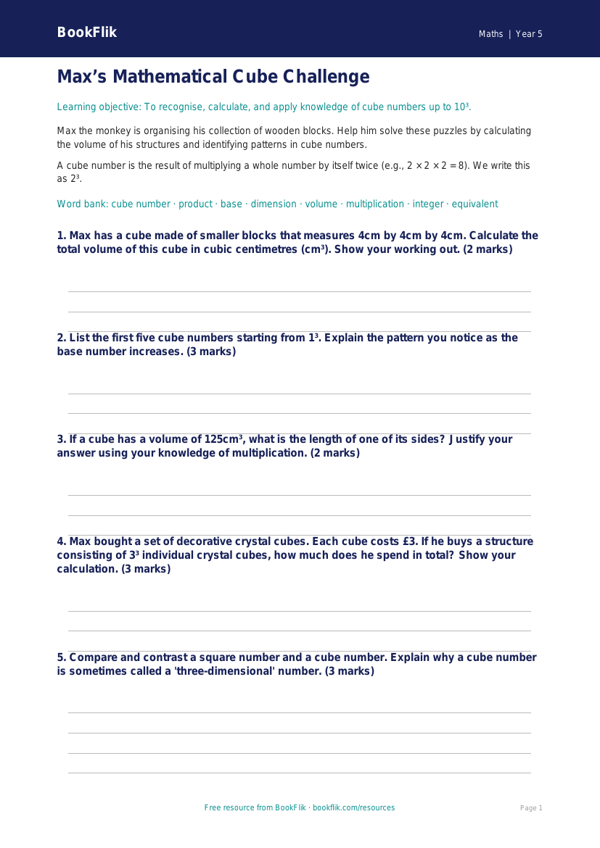
Mastering cube numbers is a fundamental step in developing numerical fluency for upper Key Stage 2. This high-quality, free Maths cube numbers worksheet year 5 greater depth resource is designed to stretch the most capable learners, moving them beyond simple recall into the realm of mathematical investigation and logical reasoning.
In this lesson, pupils will explore the relationship between cube numbers and their geometric representation. While standard curriculum tasks focus on calculating 1 cubed, 2 cubed, and 3 cubed, this Maths cube numbers worksheet year 5 greater depth encourages students to identify patterns, explore the relationship between cube numbers and square numbers, and solve complex multi-step problems involving volume and indices. By engaging with these abstract concepts, children will strengthen their ability to recognise sequences and apply their knowledge of multiplication to more sophisticated problem-solving scenarios.
Teachers can use this resource as a standalone challenge for early finishers, as a targeted small-group intervention for those demonstrating mastery, or as a homework extension to provoke deeper mathematical discourse. Because this Maths cube numbers worksheet year 5 greater depth aligns perfectly with the UK National Curriculum requirements for multiplication and volume, it provides a seamless way to assess whether pupils can justify their answers and explain the logic behind their calculations.
The worksheet includes 8 carefully curated tasks. These range from calculating missing values in algebraic expressions to creative challenges, such as:
1. Explain why a cube number is always the result of multiplying a number by itself three times.
2. Compare and contrast the growth rate of square numbers versus cube numbers.
3. Justify whether it is possible for a cube number to end in the digit 2.
4. Calculate the total cost if each unit cube in a 4x4x4 cube costs £0.50.
5. What might happen if we doubled the side length of a cube?
6. Create your own investigative sequence using cube numbers.
Download this essential resource today to inspire your most curious mathematicians.
Preview the worksheet
If the preview does not load, open the PDF in a new tab.