
Free Geometry Poster | Year 5 Greater Depth | BookFlik
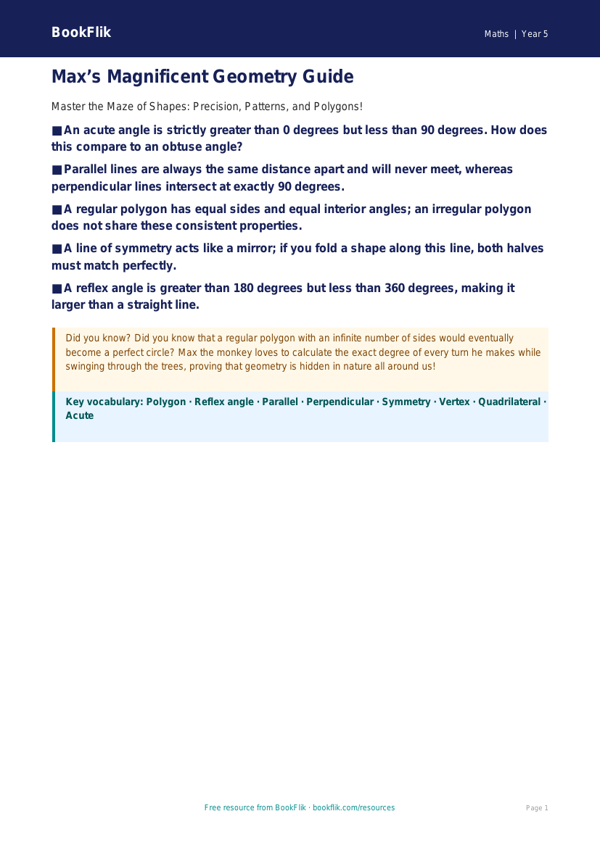
Boost your classroom displays with our vibrant and challenging Maths geometry poster year 5 greater depth resource. Designed specifically for high-achieving pupils, this educational tool moves beyond basic shape recognition to explore the complex properties of polygons and angles. By using this Maths geometry poster year 5 greater depth, teachers can encourage students to delve into the intricacies of reflective symmetry, translation, and the precise calculation of missing angles around a point or on a straight line.
Our poster features Max the enthusiastic monkey, who guides learners through sophisticated geometric challenges. It aligns perfectly with the UK National Curriculum requirements for Year 5, ensuring that pupils develop a deeper mastery of spatial reasoning. Whether you are teaching about regular and irregular polygons or exploring the properties of 3D shapes and their nets, this resource acts as a vital visual aid for independent study and small-group discussions.
This premium resource is intentionally differentiated for greater depth. While standard geometry tasks might focus on identification, our poster prompts learners to justify their reasoning and analyse geometric patterns. It is an ideal addition to any primary classroom looking to stretch the mathematical thinking of gifted and talented students. By integrating this Maths geometry poster year 5 greater depth into your lessons, you provide a sophisticated framework that supports pupils in articulating their mathematical understanding with precision.
The resource includes six higher-order thinking questions to push boundaries:
1. Explain why a regular polygon must have equal interior angles.
2. Compare and contrast the properties of a rhombus and a parallelogram.
3. Justify your answer: Can an obtuse-angled triangle ever be equilateral?
4. What might happen if you translated a shape by the vector (3, -2) on a coordinate grid?
5. Prove that the sum of angles in a quadrilateral is always 360 degrees.
6. Design a composite shape using three different polygons and calculate its total perimeter.
Preview the worksheet
If the preview does not load, open the PDF in a new tab.