
Free Non Verbal Reasoning Template | Year 5 Greater Depth | BookFlik
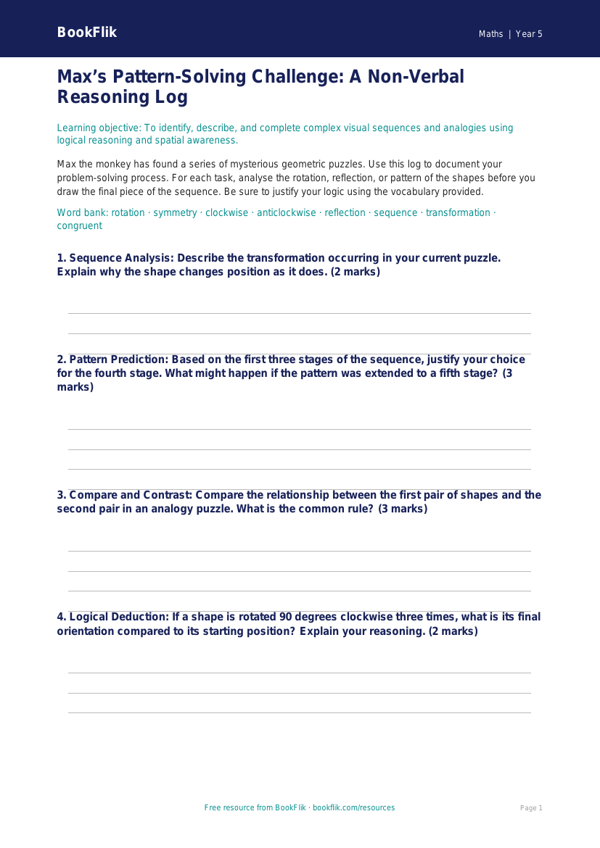
Boost your pupils’ cognitive agility with our comprehensive Maths non verbal reasoning template year 5 greater depth resource. Designed specifically for Year 5 learners who require an intellectual challenge beyond standard curriculum expectations, this pack fosters advanced problem-solving, spatial awareness, and logical deduction skills.
This resource helps children master complex sequences, rotation patterns, and reflective symmetry. By using this Maths non verbal reasoning template year 5 greater depth, students will move past basic recognition and begin to identify intricate geometric rules. Whether exploring sequences where shapes undergo multiple transformations or deciphering complex grid-based puzzles, pupils will develop the analytical rigour required for secondary transition and competitive assessments.
Teachers can integrate this resource into their weekly provision as a sophisticated extension activity for early finishers or as a focused workshop for gifted and talented groups. The materials are carefully structured to align with the UK National Curriculum focus on reasoning and mathematical fluency. By engaging with this Maths non verbal reasoning template year 5 greater depth, children learn to justify their choices, compare contrasting patterns, and articulate the logic behind their visual observations.
The pack includes 8 higher-order thinking questions designed to stretch the most capable minds:
1. Explain why a specific rotation pattern might be considered more complex than a simple translation.
2. Compare and contrast two different geometric sequences; what common mathematical rule governs both?
3. Justify your answer when selecting the next shape in a sequence that involves both colour and size variations.
4. What might happen to the final pattern if the initial rule was reversed?
5. Create your own sequence using at least three distinct transformation rules.
6. Analyse the relationship between the shapes provided and identify the outlier.
7. Predict the position of a shape after a 270-degree clockwise rotation.
8. Critically evaluate whether a pattern can be solved using two different logical methods.
Download this resource today to provide your Year 5 students with the intellectual stimulation they deserve.
Preview the worksheet
If the preview does not load, open the PDF in a new tab.