
Free Prime Numbers Flashcards | Year 5 Greater Depth | BookFlik
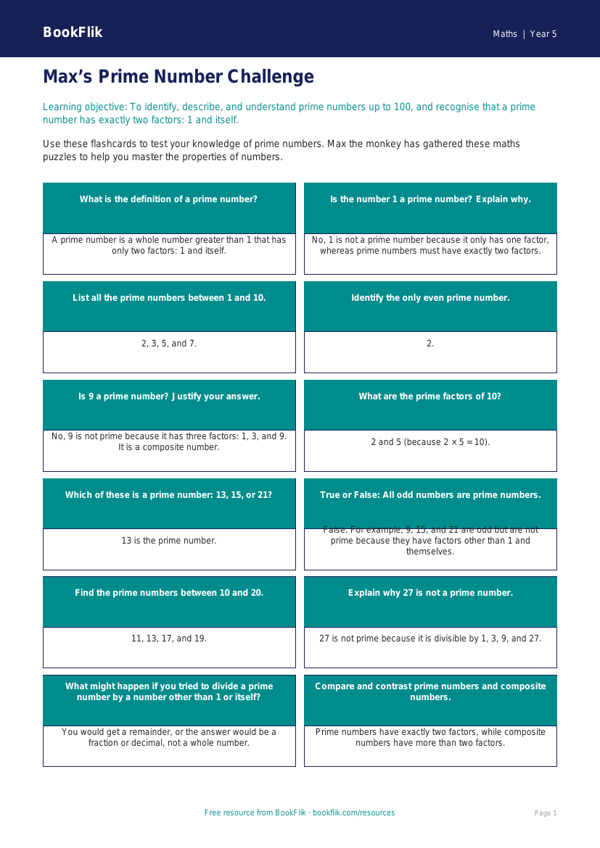
Unlock the potential of your most mathematically curious students with our comprehensive set of Maths prime numbers flashcards year 5 greater depth. Designed specifically for the Year 5 UK National Curriculum, these resources move beyond basic identification to challenge learners to explore the sophisticated patterns hidden within number theory.
These expertly crafted materials help pupils master the definition of a prime number—a natural number greater than 1 that has no positive divisors other than 1 and itself. By using these Maths prime numbers flashcards year 5 greater depth, children will move past simple rote memorisation. They will begin to investigate prime factors, identify composite numbers, and explore the Sieve of Eratosthenes, building a profound conceptual understanding of how primes function as the building blocks of all integers.
Teachers can integrate these cards into daily warm-ups, small group interventions, or as an independent extension task for gifted and talented learners. The pack includes standard identification cards alongside complex reasoning prompts designed to stretch cognitive ability. Because these Maths prime numbers flashcards year 5 greater depth are differentiated for the highest achievers, they include higher-order thinking questions that demand justification and analytical rigour.
Each set is aligned with the UK National Curriculum, specifically supporting the requirement for pupils to know and use the vocabulary of prime numbers, prime factors, and composite numbers.
Challenge your class with questions such as:
1. Explain why the number 1 is not classified as a prime number.
2. Justify why all prime numbers greater than 2 must be odd.
3. Compare and contrast prime numbers with square numbers.
4. What might happen if we tried to factorise a large number using only composite factors?
5. Prove that there are no even prime numbers greater than 2.
6. Create a mathematical argument for why the number 57 is or is not a prime number.
7. Design a strategy to identify all prime numbers up to 100.
8. If a prime number is multiplied by another prime number, what type of number is the product?
Preview the worksheet
If the preview does not load, open the PDF in a new tab.