
Free Probability Poster | Year 5 Greater Depth | BookFlik
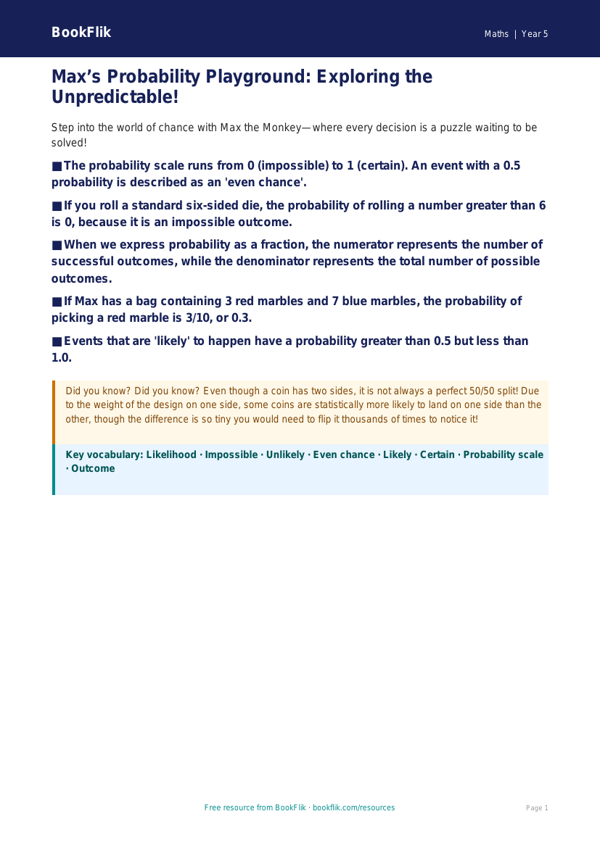
Mastering the language of chance is a vital skill for Year 5 pupils. Our exclusive educational resource, the Maths probability poster year 5 greater depth, is designed to challenge high-achieving learners beyond the standard curriculum requirements. This vibrant, classroom-ready poster moves past simple “likely or unlikely” scenarios, introducing students to the mathematical precision of fractions, decimals, and percentages when calculating the likelihood of independent events.
This Maths probability poster year 5 greater depth is perfect for display in your classroom or as a scaffolded reference sheet for small group interventions. It aligns perfectly with the UK National Curriculum, which expects pupils to understand the concept of probability as a scale from 0 to 1. By using Max the monkey as a guide, students are encouraged to view real-world scenarios as complex puzzles. The poster features clear definitions of sample spaces, expected outcomes, and the difference between theoretical and experimental probability.
Teachers can use this resource to spark high-level classroom discourse. It is specifically differentiated for gifted and talented learners, featuring extension prompts that require students to justify their reasoning rather than simply providing a numerical answer. With this Maths probability poster year 5 greater depth, you can support your most able mathematicians as they explore complex probability trees and investigate why certain events are mutually exclusive.
The resource includes a range of challenging tasks:
1. Explain why the sum of all possible outcomes in a probability experiment must equal 1.
2. Compare and contrast theoretical probability with experimental results.
3. If a fair six-sided die is rolled 60 times, justify why you might not get exactly 10 of each number.
4. What might happen to the probability of an event if the sample space is altered?
5. Design an experiment to test a prediction and record your data as a fraction.
6. Create your own “impossible” scenario and explain the mathematical reasoning behind your classification.
Preview the worksheet
If the preview does not load, open the PDF in a new tab.