
Free Square Numbers Poster | Year 5 Greater Depth | BookFlik
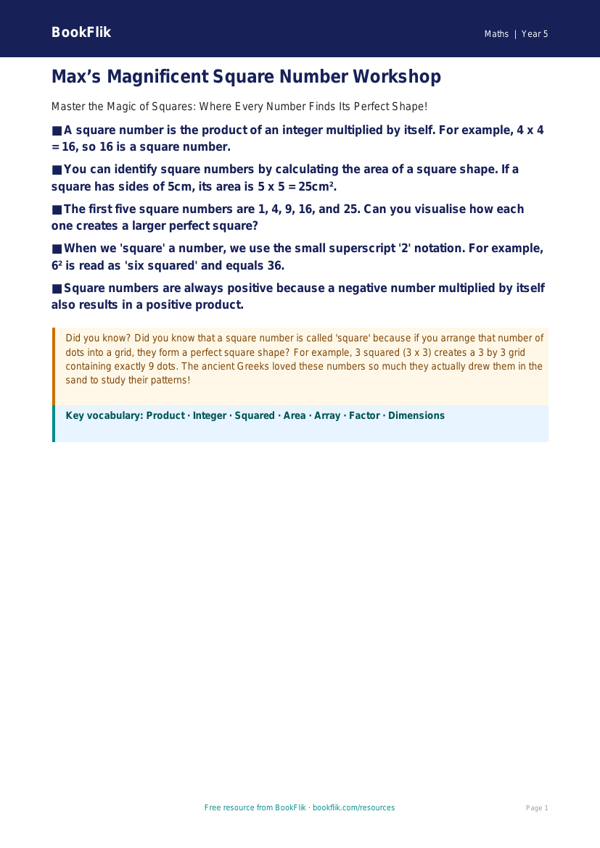
Boost your classroom displays with our vibrant and engaging Maths square numbers poster year 5 greater depth resource. Designed specifically for UK National Curriculum Key Stage 2 pupils, this high-quality educational tool transforms the abstract concept of square numbers into a visual, tactile experience. By exploring the relationship between geometry and arithmetic, students will move beyond simple rote memorisation to understand that a square number is the product of an integer multiplied by itself.
Our Maths square numbers poster year 5 greater depth is perfect for teachers looking to stretch their most able learners. While the core curriculum focuses on identifying and naming square numbers up to 12 squared, this resource provides the necessary scaffolding to explore patterns, sequences, and algebraic reasoning. Whether used as a focal point for a maths working wall or as a prompt for small group investigations, it encourages pupils to spot the connection between geometric area models and numerical values.
The resource is meticulously differentiated to ensure gifted and talented students remain intellectually stimulated. Beyond standard identification, the poster includes complex challenges that require learners to apply their knowledge to larger numbers, investigate the gaps between consecutive squares, and solve problems involving perimeter and area. Using this Maths square numbers poster year 5 greater depth, educators can foster a deeper mastery of number properties.
The pack includes six rigorous questions designed to provoke higher-order thinking:
1. Explain why the sum of two consecutive odd numbers is not always a square number, but the sum of consecutive odd integers starting from one always results in a square.
2. Compare and contrast the properties of square numbers with prime numbers.
3. Justify your answer: Is it possible for a square number to end in the digit 2? Why or why not?
4. What might happen if we represented square numbers using cubes instead of squares?
5. Prove that the difference between two consecutive square numbers is always an odd number.
6. Create an algebraic expression to represent the nth square number.
Preview the worksheet
If the preview does not load, open the PDF in a new tab.