
Free Dynamics Poster | Year 5 Greater Depth | BookFlik
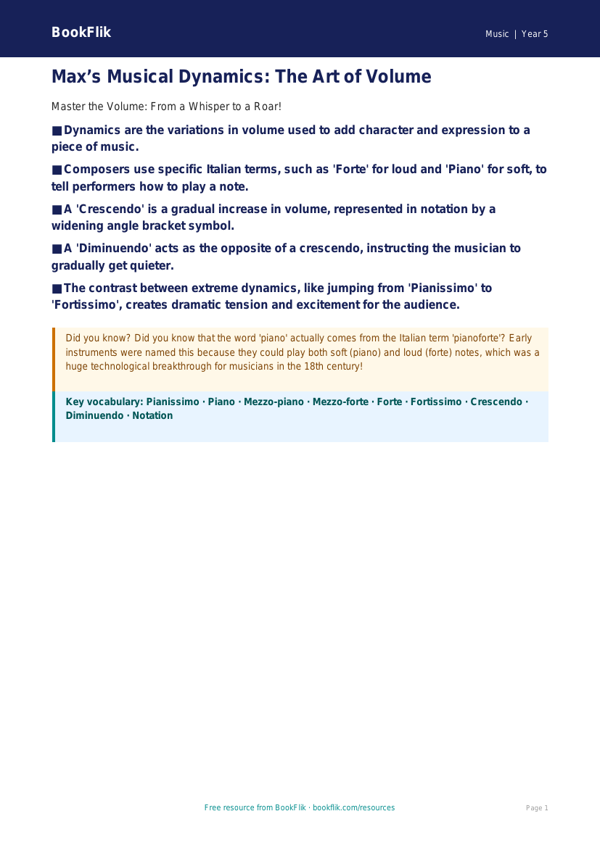
Enhance your classroom walls with our comprehensive Music dynamics poster year 5 greater depth resource, designed specifically to challenge high-achieving pupils. This vibrant, educational tool provides a clear visual guide to musical volume, moving beyond simple terms like loud and quiet to explore the nuanced Italian terminology used by composers throughout history.
Our Music dynamics poster year 5 greater depth resource is perfectly aligned with the UK National Curriculum for Key Stage 2, which requires students to understand how music is organised and how performers use expressive qualities to convey emotion. By studying this poster, children will move past basic identification and begin to analyse how composers use dynamics to create tension, release, and atmosphere within a piece. It is an ideal companion for both listening activities and practical composition sessions.
Teachers can use this resource to spark sophisticated discussions about musical intent. For instance, you might display the poster during a focused listening exercise, asking students to identify the specific dynamic shifts in a classical orchestral recording. Because this is a Music dynamics poster year 5 greater depth tool, it includes advanced concepts such as crescendo and decrescendo, as well as the subtle variations found in mezzo-piano and mezzo-forte.
To stretch your gifted and talented learners, we have included a series of higher-order thinking questions on the reverse of the poster. These include:
1. Explain why a composer might choose to use a sudden sforzando rather than a gradual crescendo.
2. Compare and contrast the dynamic range of a solo flute performance with that of a full symphony orchestra.
3. Justify your answer: Does a change in volume always suggest a change in the mood of a piece?
4. What might happen if a piece of music were played with no dynamic variation at all?
5. Discuss how dynamics can be used to represent physical movement in a story-telling composition.
6. Create your own short rhythmic pattern and annotate it with dynamic markings to convey a thunderstorm.
Preview the worksheet
If the preview does not load, open the PDF in a new tab.