
Free Pitch Poster | Year 5 Greater Depth | BookFlik
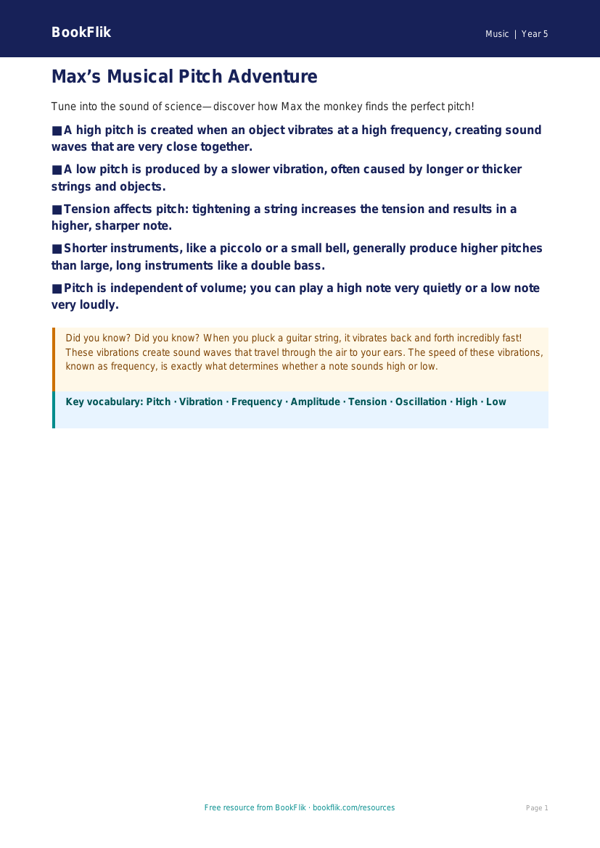
Enhance your classroom walls with our comprehensive Music pitch poster year 5 greater depth resource. Designed specifically for Key Stage 2, this educational visual aid provides a sophisticated exploration of how pitch functions within musical compositions. Whether you are teaching the fundamentals of frequency or exploring complex melodic structures, this Music pitch poster year 5 greater depth is the perfect companion for your music curriculum.
Our poster defines pitch as the highness or lowness of a sound, directly linked to the frequency of vibrations. It encourages pupils to move beyond simple identification and engage with scientific and artistic concepts, such as how string length, tension, and thickness affect the pitch of an instrument. This aligns perfectly with the UK National Curriculum, which requires Year 5 pupils to understand how musical elements can be combined and controlled.
Teachers can use this resource to spark high-level classroom discussions. By displaying this Music pitch poster year 5 greater depth, you provide a reference point for students to analyse how composers manipulate pitch to evoke specific emotions or create tension within a piece of music. It is an ideal tool for facilitating deeper inquiry, encouraging learners to justify their musical choices during composition tasks.
This resource is tailored for learners exceeding age-related expectations. It includes a section on the relationship between pitch and intervals, challenging pupils to explain why certain note combinations sound harmonious while others create dissonance. With clear diagrams and challenging vocabulary, it supports pupils as they develop their musical vocabulary.
The poster features six thought-provoking questions, including: Explain why a shorter string produces a higher pitch; Compare and contrast the pitch range of a cello and a violin; and What might happen if a composer used only low-pitched notes throughout an entire symphony? Download this essential teaching aid today to inspire your young musicians.
Preview the worksheet
If the preview does not load, open the PDF in a new tab.